Welcome to our news and history blog!

Welcome to our news and history blog!

Wednesday, December 23, 2020

'It Was In The Way; It Must Go: Old House On Lafayette Place Torn Down (1899)

Source: Greenwich Graphic: October 28, 1899, Page 1.


Had Stood There for Two Centuries, When the Road was but a Cow Path and the Indians Passed the Door.

One of the old landmarks of Greenwich, that kept us in mind of the Revolutionary War, and the days when our town was the home of Cos Cob and Amogerone, are going, and soon they will have all disappeared. They are being pushed aside by what follows in the wake of wireless telegraph, electric cars, automobiles, and the rush of these closing days of eighteen hundred, which seem to sweep everything before them that interferes with money getting and money making.

It's the penalty of being near a metropolis, and the result of the development of Greenwich, that these old mills, old houses and old bridges, closing linked with the Revolutionary War are being obliterated.

Now and then you will hear some antiquarian breathe a sigh of relief at what seems to show wanting destruction of these things so bold, so picturesque, so historic, but as a rule the throng that passes by cares not for such relics and would rather see them go, and even the old names of our streets annoy many of them.

But there are some who drop, in thought, a tear as they realize what Greenwich is losing.

The old house in Lafayette Place has disappeared, its days of usefulness were over, and it was in the way, and so it had to go. Thus another of the old landmarks of Greenwich is destroyed by the development and growth of our town.

In the days of the Revolutionary War, Lafayette Place was but a cow path, as it were, but it was the road to White Plains and the Hudson. This old house stood there long before the war, and was no doubt one of the best in its day. Its timbers show that, and the foundation indicates that much care was taken in its construction.

All that is left now of the old building is the big chimney, which stands there, conspicuous on account of its size and peculiar shape. It looks as though as if in those early days that the chimney was first erected and the house built around it.

The old dwelling stood on the grounds of Mrs. F. A. Warburton and was torn down to make room for a residence to be erected for Mrs. Warburton's daughter.

Mrs. Warburton hesitated a long time before she decided to have it removed. At first it was her intention to keep it intact as far as possible and add to it, and fill it up with moderate improvements, but this was found to be impracticable. Another idea was to move it and preserve it, but the big chimney and its peculiar construction would not allow this to be done. So this week Mr. Oliver Knapp took it in hand and soon it was a thing of the past, and before another season goes by a handsome residence will occupy the site.

It was a very old landmark, some people say that it was the oldest house in Greenwich, perhaps it was, if not it was among the first built in our town.

Its timbers were very large and joined in places with wooden spikes, and some of these are well preserved. The wall lathes were all hand-made, their unevenness showing that they were hand-made with a hatchet. They are of oak with big, hand wrought iron nails clinging to them as firmly and tenaciously as though loathed to be separated, so long have they been together. The long cypress shingles are worn to paper thinness on the edges where they were exposed to the air, and there are grooves in them made by the rains of a century or more.

In the GRAPHIC of May 13, we gave a picture and a description of the old house which we reprint.

Everybody about the village will recognize this picture. It's the old house on Lafayette Place and it sits perched upon a bank as though it was not "part or parcel" of the houses surrounding it, and neither is it.

It has so much contrast with its neighbors, that it is the most conspicuous building on this short street.

"When was it built?" That is hard to say. Some who pretend to know will tell you that it was put up in 1650. Its appearance indicates that it is at least 200 years old. Look at the old shingles, the hand-wrought nails sticking out here and there, and the big stone chimney, and the general dilapidated appearance of it – although that is not always a sign of age, but in this case it is easy to see that it is very old.

This property was owned way back in 1725 by John Hobby, who sold it to Nathaniel Mead..

It was known at one time as the Dunton Homestead, we lived Royal Dunton and his family..

Its size and shape is different from the houses that were built during the Revolutionary War, it's a very old settler and it was famous years ago..

Mrs. Mary Thompson, whose maiden name was Banks, with whom we talked about the old house, so that her grandmother and her mother and herself were all born there, and the house was very old in those days. But she thinks it is about 250 years old. But it can't be quite an ancient is that, for Greenwich was settled in 1645, but that was probably one of the first houses erected.

Mr. Joseph E. Russell considers it one of the oldest houses in town. When he was a boy it looked as aged as it does now..

When Nathaniel Mead occupied it, which was during the Revolutionary War, Cowboys and the British made raids upon his herd of cattle, and he always kept his musket handy day and night. In the field and by his bedside, it was his constant companion. We can well imagine what a beautiful farm it must have been in those days, the lay of the land must have been ideal.

They tell funny stories of one Thomas Mead, who was known as the fat fiddler, who lived there. He weighed, it is said, 400 pounds. He disliked to walk any distance, and when they wanted him to play, they went back a cart with oxen up to the door and he would get in and off they will go, carrying him to the place where his fiddle and bow were wanted.

He was exceedingly popular with the young people, and his presence was always necessary for a merry evening. It is said, too, that notwithstanding his great weight, and his disinclination to walk he was a graceful dancer and it was light upon his feet when whirling a Colored girl over the floor. Mr. Mead lived in this house many years, and when he died the door sash had to be removed to allow the coffin to pass out.

Some years ago the house was purchased by Augustus Lyon. At one time Arza Banks resided there and worked in a little shop near the house as  shoemaker but this small building has disappeared.

It is said that an English officer who had been wounded was taken to the house and died in the south room.

But if you want to judge the house and its age, go in side and see that long, wide room on the first floor, which is almost the same as when around the big fireplace the family and neighbors gathered 150 or more years ago. The ceiling is so low that a man of six feet must stoop to walk about. The quaint doors hang on the same hinges, and the little iron latches appear to have been made at the time the house was erected. There is, perhaps, no house in Greenwich that would impress you with its age, than this one, after you have taken a look at the inside of it.

It is going to pieces rapidly, and can't last but a few years more as it now stands. 

It is owned by Mrs. Francis Warburton.


Worthy of Being Emulated: A New Road Presented to the Town (1888)

 Source: Greenwich Graphic. June 9, 1888. Page 3


A LARGE QUANTITY OF DESIRABLE BUILDING PROPERTY OPENED UP BY THE LIBERALITY OF MRS. TITUS MEAD.


North street and vicinity are to many people the most desirable section for suburban homes, of any of the fine building sites in Greenwich. Some buyers of property prefer Belle Haven, with its exquisite marine views and bracing sea air; others preferred to live away from the water's edge, and to these North street has a charm which no other portion of the town possesses. Then, too, besides the location there are no drawbacks of any kind. High, with magnificent scenery, splendidly drained yet near the village, but still away from it, the land has been quickly purchased, as soon as put on the market, upon which rural cottages of unique design, exceeding all in costliess and beauty those which have made Elberson so famous, have been built.


The section is now destined to be more popular than ever through the liberality of Mrs. Titus Mead, who has set an example worthy of ambulation. This lady has not waited for a town meeting to vote a road through her land, which will be of great benefit to the property, but instead he's open to road at her own expense through her land, connecting to large thorough fairs together, and opening up a splendid tract of land whichThe section is now destined to be more popular than ever through the liberality of Mrs. Titus Mead, who has set an example worthy of ambulation. This lady has not waited for a town meeting to vote a road through her land, which will be of great benefit to the property, but instead has opened a road at her own expense through her land, connecting two large thoroughfares together, and opening up a splendid tract of land which will eventually come on the market. Engineer Minor has surveyed this road, which starts from near the brook on North Street, running westerly to the new road, a distance of about one thousand feet. It will be 55 feet wide. Following is the diagram made by him:


Saturday, December 19, 2020

Wreaths Across America Day 2020


Today, Saturday, December 19 is National Wreaths Across America Day.


Its mission to remember our fallen U.S. veterans; honor those who serve and teach children the value of freedom. 

Cemetery Association President Jeffrey Bingham Mead was invited by the Greenwich chapter of the Daughters of the American Revolution to attend a ceremony at Tomac Cemetery in Old Greenwich. You'll see from the images that snow did not deter anyone from holding this event.

Tomac Cemetery is the oldest existing burying ground in town. It is where my original ancestors who settled in North America in the early seventeenth century are interred.


It is also the location of a memorial gravestone marker commemorating Greenwich, Connecticut 350th founding in 1990. The memorial stone was carved by Peacock Memorials in Valhalla, New York. 

Support for the creating and installation of the stone was made possible by Jeffrey Bingham Mead, Mead family descendant Ms. Helen Leale Harper, Jr., and other family descendants across the USA. 

Harper -now deceased- was the granddaughter of Dr. Charles Leale, the first doctor to attend to President Abraham Lincoln after being shot by John Wilkes Booth in Ford's Theater, Washington, D.C.

Today's ceremony was a coordinating wreath-laying effort that included others at more than 1,600 locations in all fifty states, at sea and abroad.

Mead was also invited to attend its ceremony by the Friends of The Old Burying Ground at Byram Shore Road -not far from my Greenwich residence. Unfortunately due to a scheduling conflict he was unable to attend.


Thursday, December 17, 2020

Alexander Mead and Son Plants for Christmas Presents (January 2, 1904)


The Sanford Mead House (pictured above) was built in 1845, and still stands at 349 Lake Avenue, Greenwich, Connecticut. 

It is a designated historic landmark by the Greenwich Historical Society. 


Wednesday, November 18, 2020

Their Golden Wedding: Mr. and Mrs. I.L. Mead Receive Congratulations (1905)


Source: Greenwich Graphic: December 2, 1905, Page 5.

Mr. and Mrs. I. L. Mead Receive Congratulations-Talks with Graphic About the Greenwich of 50 Years Ago. 

Mr. and Mrs. Isaac Lewis Mead held an informal reception at their home last Monday in observance of the fiftieth anniversary of their wedding. During the day more than a hundred persons paid their respects to the couple. Besides these Lombard Post G. A. R. called in a body, the deacons of the Congregational Church and the school visitors, as well as representatives of Acacia Lodge A. and F. M. 

Many pretty presents were received by the pair. Among them were a gold Grand Army badge presented by Lombard Post, a gold lined silver fruit dish presented by the visitors and a  gold masonic emblem for Mr. Mead and a gold brooch for Mrs. Mead presented by Acacia Lodge.


The Isaac Lewis Mead Building, Greenwich and West Putnam Avenues. 

Mr. Mead is a native of Greenwich, there can hardly be found a man who has for so many years kept in such close touch with the town. His naturally fine intellect has preserved all its keeness and his physical faculties have not been impaired by age with exception of his eyesight which he has almost entirely lost.

"There has been a great change in Greenwich since 50 years ago to-day," said he reminiscently to the GRAPHIC. "At the time I was married it was but a little village which had but little intercourse with the outside world. The railroad had been put through but a short time and a trip to New York was infrequent indeed to the average Greenwichite. 

"I think at that time there were but six houses on what is now Greenwich Avenue. The avenue was a mere road from the Post Road down to what is now the Steamboat dock. There were no sidewalks and the road was often in such a condition that it was necessary to walk out into the lots to get out of the mud. The road was considerably used used even before the railroad was put in, in going from the upper part of the town to Captain Caleb Merritt's sloop wharf.


"This sloop of Captain Merritt's plied between here and New York and was for a great many years a much used mode of transportation, not only of freight but of passengers. The sloop ran once a week. It started in the evening and if the weather was good generally arrived in New York somewhere near dawn.

"The business section of the town for the most part was near the corner of Sherwood Place and Putnam avenue though there were one or two stores adjacent to the building which is now called the Lenox House. The hotel was called the Mansion Hotel and was kept by Mr. Augustus Lyon. It was the only hostelry in this part of the town.

"There were no public improvements in town then, if you accept the roads. There were not even lights. I remember the first time lights were put on Greenwich avenue. I think it was just prior to the war, when the 8th regiment of the militia was camping on Mr. Sandford Mead's lot. I was then a member of the Board of Burgesses and I realized that there would be a great many people passing between the railroad and the camp ground and that there ought to be lights on Greenwich avenue. At that time the Americas Club had a club house on Indian Harbor Point where Mr. Benedict's place is now. They used a great many lamps to light the woods up when they held an entertainment of any sort. I went to the club as it was about time for it to close for the year, asked for the use of the lamps. When I got them I had them fixed to the trees all along Greenwich avenue. Those were the first lights on the avenue, but it was a long time before any were permanently places there.

"Practically no one outside knew of the town, then, as a summer resort. One of the first people to make a summer home here was William L. Tweed. It was he who brought the Americus Club out here and it was the Americus Club which through its members helped spread the fame of Greenwich as a beautiful summer place.

"Then of course other people traveling through the town on the railroad noted its beauties and came here to try them. There was a rather amusing story told of the late Mr. H. M. Benedict, brother of Mr. E.C. Benedict whose elegant villa here is one of the most magnificent in the country. For some reason or other Mr. Benedict had come to town and he visited the cemetery. Going through it and reading the various inscriptions, he remarked that there were an almost amazing number of persons who had died in the ages of eighty or ninety or even older. "Ha," he said with a smile, "if the place is so healthful that they all live to be eighty or more, its just the place for me." Somewhat later he came to live here, whether partly because of the incident or not, I don't know. Seven years ago he died at an age that was not less than those he had marveled at, graven in the old cemetery." 


Tuesday, November 17, 2020

Union Cemetery: Year 2020 Preservation and Restoration


Located off Milbank Avenue at the intersection with Davis Avenue, Union Cemetery was originally called Burying Hill, and it was an old Mead family plot. 

One hundred and sixty-nine years ago on the 2nd day of November, 1851, Robert W. Mead deeded three adjoining acres of land he owned on the south and and east side of that cemetery. Since then, Union Cemetery has been under the management and control of the Second Congregational Church of Greenwich. 


Starting May 2, the church initiated a project to clean up, spruce up and restore Union Cemetery. 

The cemetery includes a number of Mead family plots representing various branches of the family. 

This is from Spencer P. Mead's record of tombstones in the Town of Greenwich dated October, 1908:

This cemetery was originally called BURYING HILL, and it was an old family plot. On the second day of November, 1851, Robert W. Mead, the owner of the adjoining land on the east and south of the old plot, deeded to the Second Congregational Society (now the Second Congregational Church) three acres of land, in trust nevertheless, as a burial ground and for no other purpose, to be under the charge and superintendence of a committee of three persons to be appointed by said society from among those of its members who are of the church.


Union Cemetery is quite popular with local residents, including a fair share of walkers. 


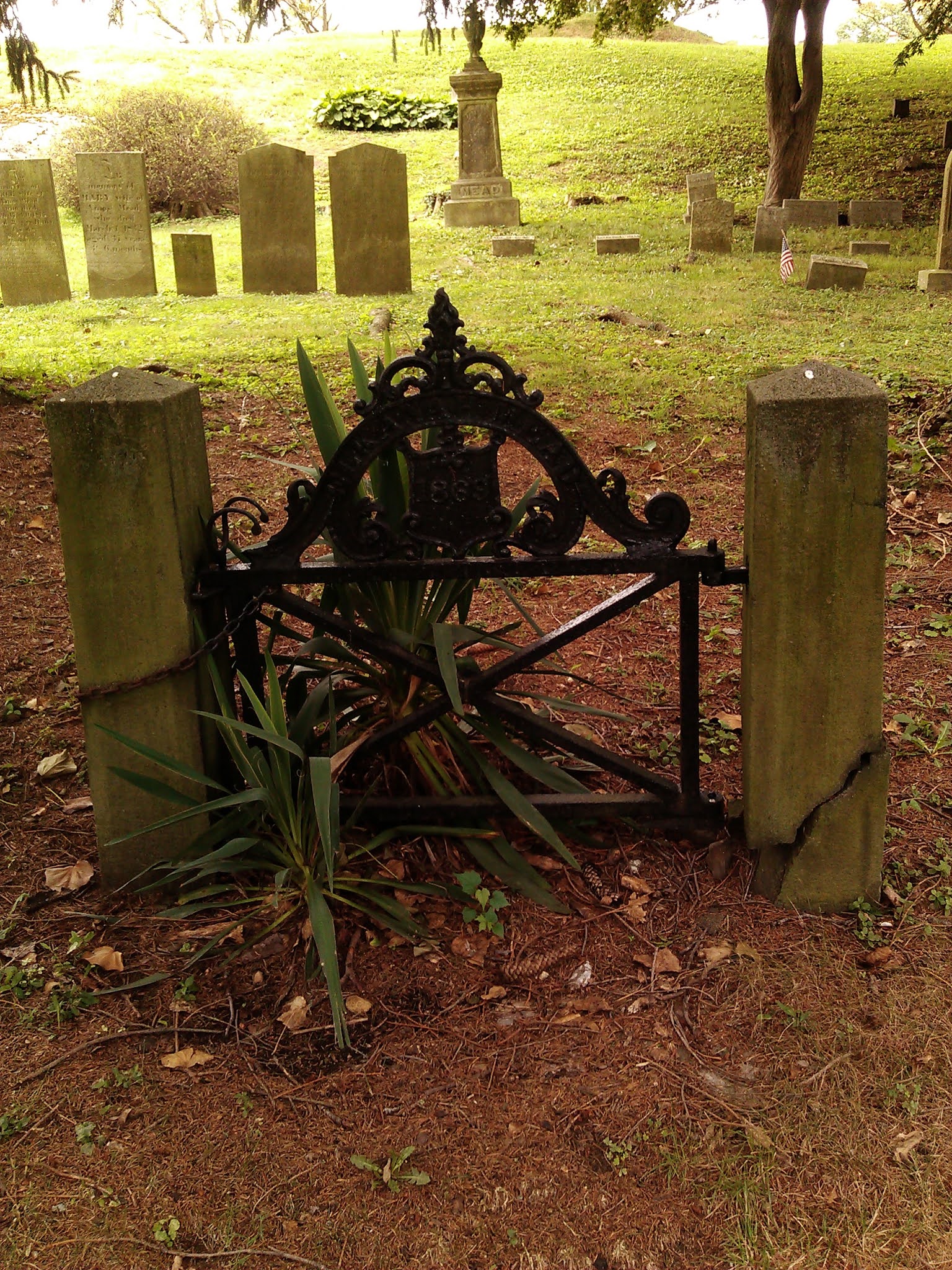
The gate to Elkanah Mead's graves site. He is the founder of the 
insurance company that bears his name. 


This image was captured in the first week of May, 2020. The cemetery features fine examples of tall specimen trees and flowering bushes, such as the azaleas pictured here. 


This image was captured in first week of November, 2020. It shows the area of the cemetery near the intersection of Milbank and Lincoln avenues at the traffic light. 


This image was captured in first week of November, 2020. It shows the area of the cemetery near the intersection of Milbank and Lincoln avenues at the traffic light. 


This is the scene in Union Cemetery on the north end closest to Davis Avenue facing south. Note the vivid red colors of the Japanese maple trees. This was captured in the first week of November, 2020. 


This is the gravestone of Hannah Mead. The stone lay buried under four inches of soil and sod for many years. Eventually it will be uprighted again. 


The Second Congregational Church of Greenwich, Connecticut -founded in 1705. The cemetery in the foreground is not Union Cemetery. It is known as the New Burial Grounds Association Cemetery, one of the first independent cemetery associations in Greenwich.