Welcome to the online news and history blog of Historic Mead Burying Grounds, Inc., Greenwich Connecticut USA
Welcome to our news and history blog!
Saturday, October 20, 2018
Fortieth Anniversary: Alexander Mead & Opening of First Greenhouses
Greenwich Graphic: December 21, 1907.
Mr. Alexander Mead, due to physical ailment that began to give him some annoyance, took occasion to go away from Greenwich in search of relief. He has gone forth and back the past several years, staying away as much as his affairs would permit. On his return in late fall he found that his general health had been improved, and it has thus far continued so evenly that he is encouraged that he may not soon again be compelled to take a prolonged trip from home.
This is the 40th anniversary of the opening by Mr. Mead of his first greenhouse: and it was not opened with expectation of engaging in the business, rather as a diversion from the prose of farming.
But at once there came such demand that almost without realizing it this enterprise became established, other greenhouses were called for, and ere long the biggest concern of its kind hereabouts was a verity, and has been maintained with notable increase as the years have flitted by.
Forty years ago the only other greenhouses near here were in Stamford. There was no competition to stimulate effort, but flower culture was his pleasure, the results were choice, and the inclination of the people toward the beautiful being invited, the demand grew and kept growing.
And down to this Christmas tide it has continued with the resultant large establishment, with its prosperous surroundings and its thousands of lovely flowers, its plants and its foliage and the urgent call. Well it deserves to be known, as it is, as one of the places to see ere a Greenwich visit is enjoyed.
The display now is particularly inviting. Poinsettias, so suitable to the time, are there in perfection. And also are azaleas, cyclamens, primroses, carnations, violets; and palms, ferns and holly, with wreaths and roping as well as cut flowers to meet every time and requirement.
Mr. Mead welcomes all calls and his green houses will continue to attractive evolution his application of intelligent and up-to-date methods has made possible, in which his personality so pleasingly supplemented.
Tuesday, September 25, 2018
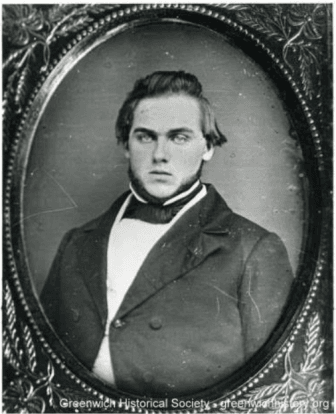
Greenwich Free Press: Remembering Daniel Merritt Mead, who served his county in a time of chaos and confusion, by Andrew Melillo
By Andrew Melillo

Photograph courtesy of Greenwich Historical Society
A few days ago on September 19, marked the anniversary of the passing of Daniel Merritt Mead, a native son of this town and one whose memory and legacy should be remembered from time to time by the town’s citizenry.
Daniel dutifully served his county in a time of chaos and confusion. He was in the Yale Class of 1854, and he passed the bar and practiced law in New York and Connecticut in 1855 and 1856.
He was a founding charter member and the first Junior Warden of the masonic lodge Acacia 85 and first formal historian of the town.
Daniel Knapp writes the following of Daniel Merritt Mead in his book, Muskets and Mansions:
“Captain Daniel Merritt Mead, a twenty-eight year old lawyer who had already written a comprehensive history of Greenwich, commanded I Company. Mead was born in Cos Cob on June 2, 1834. After attending Yale and Law School, he was admitted to the Connecticut Bar and began practicing law in Horseneck. He married Louisa S. Mead, completed his history of Greenwich in 1857, and enlisted as Captain of I Company, the Tenth Regiment, Connecticut Volunteers, on September 6, 1861.
The Tenth was mustered into service at Camp Buckingham near Hartford, Connecticut. From there, the regiment, Mead‘s I Company included, entrained for Annapolis, Maryland, where it was assigned to the First Brigade of ‘Burnside’s Division.’ With two months of training and drill to form and firm it, the regiment shipped out on transport for its first engagements in North Carolina.
The Troops remained on board for more than five weeks. Provisions were barely adequate. Sickness quickly seized the confirmed men and for the most part, life aboard the transport was miserable. Finally, on February 7, 1862, they landed on Roanoke Island, where, to the astonishment of the regular army officers on hand, the Tenth Regiment ‘fought like veterans.’
From that point on, the Tenth fought in practically all the nameless battles, fights and skirmishes that took place in eastern North Carolina and along the James River in Virginia for the remainder of the war. The battle record reads like a provincial Piedmont train schedule: Slocum’s Creek, Plymouth, Trenton, Tarboro, Rawle’s Mills, Hamilton, Williamstown, Goldsboro….
Then came Kinston, in December, 1862. Seven thousand rebels held this North Carolina hamlet. Several Union regiments had attempted to carry the enemy position – without success. Now the Tenth was called in from the rear. It passed one beaten brigade, then three regiments of another. The order was given to charge. Rolling onward, the Tenth literally had to leap over the men of three more Union regiments lying down in the line of battle.
Ahead stood a rebel brigade holding the bridge over the Neuse River and the road into the town. The Tenth routed these defenders almost peremptorily. The bridge was aflame now, set ablaze by the retreating Confederates. The Tenth raced across as the timbers crackled and the bridge began to yield beneath their weight.
Sweeping by four field pieces that had been pounding at them as they advanced, the Tenth stormed the town itself. When it was over, the regiment had captured five hundred prisoners, eleven artillery pieces, hundreds of small arms, and uncounted valuable documents. They had suffered one hundred and six killed and wounded in action.
Then came Whitehall, Goldsboro again, Sealbrook Island, James Island, then Fort Wagner. They were withdrawn for a brief rest in St. Augustine, Florida – sixty percent of the regiment incapacitated by sickness and disease.
Brief was the word for it. Soon they were back on their maddening milk run of battles. By April, 1864, the tracks cut through the once-placid country and around the James River in Virginia…Walthall Junction, Drewry’s Bluff, Deep Bottom – just nine miles from Richmond, Strawberry Plains, Springfield, Deep Gully, Fuzzell’s Mills, Petersburg, Chapin’s Farm, Fort Harrison, New Market Heights.
At one point, the entire Army Corps, of which the Tenth was a component, was suddenly exposed to a surprise attack on the North Bank of the James River. Only the Tenth Regiment saw the rebels coming. Unaided, they mobilized and turned back a Confederate force that outnumbered them ten to one.
By September of 1864, the regiment’s three-year term of enlistment was up. From this point onward, substitute recruiting filled its ranks. Only ninety of the Tenth’s original members remained until the close of the war.
One Brigade Commander had said of them, ‘…for steady and soldierly behavior under most trying circumstances….they may have been equaled – but never surpassed.’ The tribute had been paid for dearly. Some few lucky ones had returned home to Greenwich in that weary September. They majority had been cut down by cannon shards, musket balls, exhaustion and disease.
Daniel Merritt Mead had been one of those who fell. Promoted to Major for valiant service, he had contract typhoid fever in the summer of 1862. Sent home, he died in Greenwich before the leaves had turned color that same year. Daniel Merritt Mead had been, at twenty-eight, a lawyer, historian and proven leader of men under fire. What accomplishments he might have reached – for his town, his state and his country – had he survived the War of Secession.”
And so, I ask the citizens of Greenwich, from time to time, to remember Daniel Merritt Mead’s honor. To remember his sacrifice, to remember his name.
Saturday, August 11, 2018
Our Neglected Cemeteries: Greenwich Press, 1929
Greenwich Press: Thursday, January 3, 1929.
A drive about town reveals cemeteries, no longer in use, that have not only sunk into a state of oblivion but have been allowed annually to grow a crop of weeds and tall grass, overshadowing in many instances the tombstones. The Press does not know who is responsible for such a deplorable condition, but it does know that discredit is being reflected every day that this condition is allowed to continue.
The fact that Greenwich is not the only community where cemeteries have been virtually abandoned does not excuse this town. Possibly some of these cemeteries were originally family burying grounds and maintained by the family using them. Nevertheless, they still come under the classification of a cemetery and should continue to be treated with the same respect. To allow them to be forgotten is showing disrespect to the remains of those who rest there.
Were not the cemeteries dotted with tombstones erected in memory of loved ones, the offense against the dead would not be so great. But the tombstones cause their identity to stand out boldly, bringing remarks from those who pass. Visitors, in particular, notice these abandoned burying grounds and wonder why they are so treated. They stand out in startling contrast to the natural beauty of Greenwich.
Something should be done about this condition. It would cost comparatively little to bring back these cemeteries to their former beauty and to keep them in such a condition. The improvement in appearance would more than balance the expense. If the town does not feel that it should bear the expense, why could not some of our enterprising organizations put their shoulder to the wheel? Property owners in the vicinity of the cemetery might well lend their aid to the proposition. Improvement of the cemeteries could not help but increase the value of their holdings.
In any event, something should be done and be done quickly. Greenwich should never forget its dead, whether they have been dead a year or 100 years. They did their part in making this town what it is today and their memory should not be forgotten.
A drive about town reveals cemeteries, no longer in use, that have not only sunk into a state of oblivion but have been allowed annually to grow a crop of weeds and tall grass, overshadowing in many instances the tombstones. The Press does not know who is responsible for such a deplorable condition, but it does know that discredit is being reflected every day that this condition is allowed to continue.
The fact that Greenwich is not the only community where cemeteries have been virtually abandoned does not excuse this town. Possibly some of these cemeteries were originally family burying grounds and maintained by the family using them. Nevertheless, they still come under the classification of a cemetery and should continue to be treated with the same respect. To allow them to be forgotten is showing disrespect to the remains of those who rest there.
Were not the cemeteries dotted with tombstones erected in memory of loved ones, the offense against the dead would not be so great. But the tombstones cause their identity to stand out boldly, bringing remarks from those who pass. Visitors, in particular, notice these abandoned burying grounds and wonder why they are so treated. They stand out in startling contrast to the natural beauty of Greenwich.
Something should be done about this condition. It would cost comparatively little to bring back these cemeteries to their former beauty and to keep them in such a condition. The improvement in appearance would more than balance the expense. If the town does not feel that it should bear the expense, why could not some of our enterprising organizations put their shoulder to the wheel? Property owners in the vicinity of the cemetery might well lend their aid to the proposition. Improvement of the cemeteries could not help but increase the value of their holdings.
In any event, something should be done and be done quickly. Greenwich should never forget its dead, whether they have been dead a year or 100 years. They did their part in making this town what it is today and their memory should not be forgotten.
Thursday, August 2, 2018
Thursday, July 19, 2018
Surprise! Abigail Reynolds Mead Stone Returned to Its Rightful Position
This morning I went to one of our ancestral burying ground off Relay Place in Cos Cob. I received something of a surprise upon my arrival.
This particular gravestone had been toppled by some anonymous soul in September, 2017. Read about it here.
I tried uprighting it myself last week -it's not that heavy for me, just bulky.
So, you can imagine my curiosity was piqued when I found the stone back in its proper position.
We've no idea who uprighted the stone. Whoever you are -thank you.
Wednesday, November 22, 2017
Saturday, October 21, 2017
Rachel Mead's Gravestone: Returned At Last
On this unusually warm and mild autumn morning the long lost gravestone for Rachel Mead, died 1799, was finally returned to its rightful place.
With the assistance of Christopher Shields, archivist of the Greenwich Historical Society, we were able to pinpoint the cemetery where the stone belonged. Her grave is in the New Burial Grounds Association Cemetery next to the Second Congregational Church of Greenwich.
We used the Hale Collection of gravestones from the archives. These are not available online at this time.
The gravestone arrived in a trailer towed by Norm Davis, a direct Mead descendant of Joshua and Rachel Mead. The stone is a brownstone that measures 6" by 20" and about 30" tall.
We appreciate the cooperation and support of Allen Wilson, one of the cemetery association's directors.
This was posted by Norm Davis on Facebook:
With the assistance of Christopher Shields, archivist of the Greenwich Historical Society, we were able to pinpoint the cemetery where the stone belonged. Her grave is in the New Burial Grounds Association Cemetery next to the Second Congregational Church of Greenwich.
We used the Hale Collection of gravestones from the archives. These are not available online at this time.
The gravestone arrived in a trailer towed by Norm Davis, a direct Mead descendant of Joshua and Rachel Mead. The stone is a brownstone that measures 6" by 20" and about 30" tall.
We appreciate the cooperation and support of Allen Wilson, one of the cemetery association's directors.
This was posted by Norm Davis on Facebook:
This story begins many years ago. Many, many years. All good stories have a beginning, a middle and an end. But it’s hard to say when this story really begins. So I’ll pick a date, and work in both directions. Bear with me.
My parents bought their house in Port Chester, NY in 1956. The house had been built in 1927. Sometime around 1962 my dad dug up a series of stones that had been serving as a sort of rough, and dangerous, set of steps up a slight hill in the backyard. One of the slabs was quite large. He rolled it over, and discovered that it was a broken headstone. The writing was very clear: Rachel Mead, wife of Joshua Mead, departed this life Dec. 7, 1799 in the 50th Year of her age. My dad had been working on our family history since his teens, knew all the main colonial families in the Westchester and Fairfield county areas, and recognized the surname Mead right away. The Mead family is one of the earliest settlers of Greenwich, and has dozens, if not hundreds, of descendant branches by now. Their records are well established in churches and land documents.
He did a little digging, so to speak. Anyone who does genealogical research knows the routine. Dead ends, misinformation, family lore, a deliberate secrecy around events that families preferred to keep out of the public records. After just a bit of sleuthing, he proudly announced to us one day that he had found the records of Rachel Mead - and we were direct descendants. I’ll layout the details below. The mystery of course is, how did the stone end up in Port Chester, at the house he bought. When, where, who. Those details would take a bit more work.
Rachel Mead does have a headstone at the Second Congregational Church in Greenwich. So it’s not missing. Jeffrey Bingham Mead, who is heavily involved in the Mead Family records as well as Greenwich history in general, helped fill in some gaps. In 1918, there was a storm that toppled some scaffolding that has been erected for steeple repairs. Many headstones were damaged, and subsequently replaced. Rachel’s headstone was apparently one of them. How did it end up in Port Chester, at a house that didn’t exist until 1927? That’s the part of the story that I haven’t been able to fill in. Maybe the contractor who replaced the headstones took the broken ones to use on projects. Maybe it went to a dump and was saved by someone who thought it was useful. I don’t know. But it was AWOL for about 10 years at least.
Through luck and stubbornness, I found Jeffrey online and contacted him. You can read about that on his Mead Burying Grounds website: http://meadburyinggrounds.blogspot.com/... Jeffrey generously stepped in an arranged to have the stone repatriated. It was more than I had hoped for. My best friend and brother-from-another-mother Don Barbro came to help, with his son-in-law Peter Hudson, and my wife Lu-Anne. We loaded Rachel onto the trailer, and soon her headstone was back where it belonged, just a couple of feet away from where it was originally placed in 1799.
I have to say that it proved to be a lot more emotional than I had anticipated. Rachel is a total stranger to me of course, in spite of the bloodline. And it’s not like this act corrected a years-long miscarriage of justice. I had decided a long time ago that the stone belonged with a Mead family caretaker, and frankly I didn’t really care who that might be. I just couldn’t bear the thought of leaving the stone in the cellar, or on the curb. Jeffrey had the right idea and I am so grateful that he was able to get permission to do it, and then actually dig the hole for it. But standing there, on a sunny Saturday morning, it occurred to me that here we were - gathered, like so many family and friends often have to do, in a cemetery. We were standing exactly where Rachel’s family must have stood, on what was surely a miserable day in December. Perhaps her husband Joshua laid his hand on the headstone before turning away. I like to think so. And I like to think that in some way, this little act has brought Rachel’s story full circle - again.
So, if you’ve stayed with the story so far, thank you. I’m almost done with telling the public part of it, although personally the story will probably consume a few more hours of my free time. I’ve told the story from the middle, going forward. For anyone interested, I will now go backward. Here’s how the ancestral link works. The * means I have actual family photos of the person. b.=birth, d.=death.
Norman Davis III b.1954 (that’s me):
- My father - Norman Davis Jr, Port Chester, b. 15 Apr. 1927 d.7 Aug.1993 *
- His mother - Marion Bitz Davis Wilson, Port Chester, b. 19 Sept. 1902 d. 18 Feb.1996 *
- Her mother - Mary I. Guthrie Bitz, Port Chester *
- Her mother -Mary B. Guthrie, Greenwich, b.22 Mar.1871 * She was frequently photographed with her sister Kate (Chapman *), apparently they were quite photogenic. You can be the judge.
- Her mother - Mary Frances Mead, Greenwich, b. 14 Sept.1846 d.1926 * (She married William Guthrie (b. 23 Dec. 1846 d. 6 Jul 1907 *). The Guthrie family also has deep roots in Greenwich, and even deeper roots in Scotland. Our family is direct descendants.
- Her father - Leonard Mead, Greenwich, b. 2 Mar.1807 d.6 Jan.1857 * Leonard married Frances Studwell b. 9 Mar. 1822 d. 27 Jul.1905 *. The Studwell family traces it’s roots to the very first settler in Rye, under grants from the King. Our family is direct descendants.
- His father - David Mead, Greenwich, b. Jun 1778 d.27 Aug.1828. David was married to Chloe Barnum, b.Apr.1781 d.26 Mar.1841, also a prominent Greenwich family.
- His mother - Rachel Knapp Mead, b.1750 d.1799. Rachel was married to Joshua Mead b.1751 d.1812; Joshua was a Colonial militia sergeant who fought in the Revolutionary War.
So that’s the unbroken chain. Thanks for the ride, Rachel, now please Rest In Peace.
Subscribe to:
Posts (Atom)


