Welcome to our news and history blog!

Welcome to our news and history blog!

Saturday, January 30, 2021

ANNOUNCEMENT: Caroline Mills Smith Mead Memorial Garden and Mead Family Cemetery at Cos Cob


Caroline Mills Smith Mead (Mrs. William H. Mead)

The Historic Mead Family Burying Grounds Association, Inc., announces the establishment of the Caroline Mills Smith Mead Memorial Garden at the Mead Family Cemetery in Cos Cob. 

The Caroline Mills Smith Mead Memorial Garden was established in conjunction with the centennial of the passage of the 19th Amendment to the United States Constitution granting women the right to vote in elections. 

"While Mrs. Mead was not known to be a suffragist, the garden pays respects to a woman whose business acumen, foresight and philanthropy were well-known throughout Greenwich," said Jeffrey Bingham Mead, historian and founder of The Historic Mead Family Burying Grounds Association.

From the Greenwich News, June 10, 1910, page 7, column 5: "Mrs. Mead was a prominent woman in Greenwich, a woman of strong character in mind and one highly respected in town. She was born in 1826 in Stamford, the daughter of Ebenezer and Rhoda Smith. On her marriage to Mr. Mead she came to Greenwich to live in the old homestead which is now occupied by Mr. Young. Thirty-seven years ago her husband died and upon her then devolved the task of looking out after his large land holdings. In recent years she has done much to improve the property. She had four streets laid out, Mead Circle, Suburban avenue, Glendale street, and Randolph place, all of which are well built up. She showed remarkable business ability in all of her dealings, and much to build up Cos Cob. Mrs. Mead was one of the oldest members of Christ Church and was active in church work. She was a member of the New Canaan chapter of the D.A.R."


Caroline Mills Smith Mead's 'Mead Circle' real estate development in Cos Cob. Map dated 1906.

In 1906, Mrs. Mead laid out streets and developed real estate from her late-husband's lands she inherited upon his death. The area was at one time known as Mead Circle. It included Suburban Avenue, Tremont Street, Randolph Place, Glendale Street and some housing plots along the east side of Sinawoy Road. 

From Greenwich Graphic, June 11, 1910 after she died: "Mrs. Mead owned a large acreage of Cos Cob property, and although advanced in years was deeply interested in building up that part of the town, opening up her land into desirable building lots, handsome cottages having been built on many, Mrs. Mead's wish being that only a good class of houses be constructed, and the attractive section known as Mead Circle, which has so rapidly built up the past few years, was a part of her holdings." 

For example: 10 Tremont Street (circa 1900), 19 Tremont Street (circa 1910), , 23 Tremont Street, was built circa 1906, as well as 25 Tremont Street. 


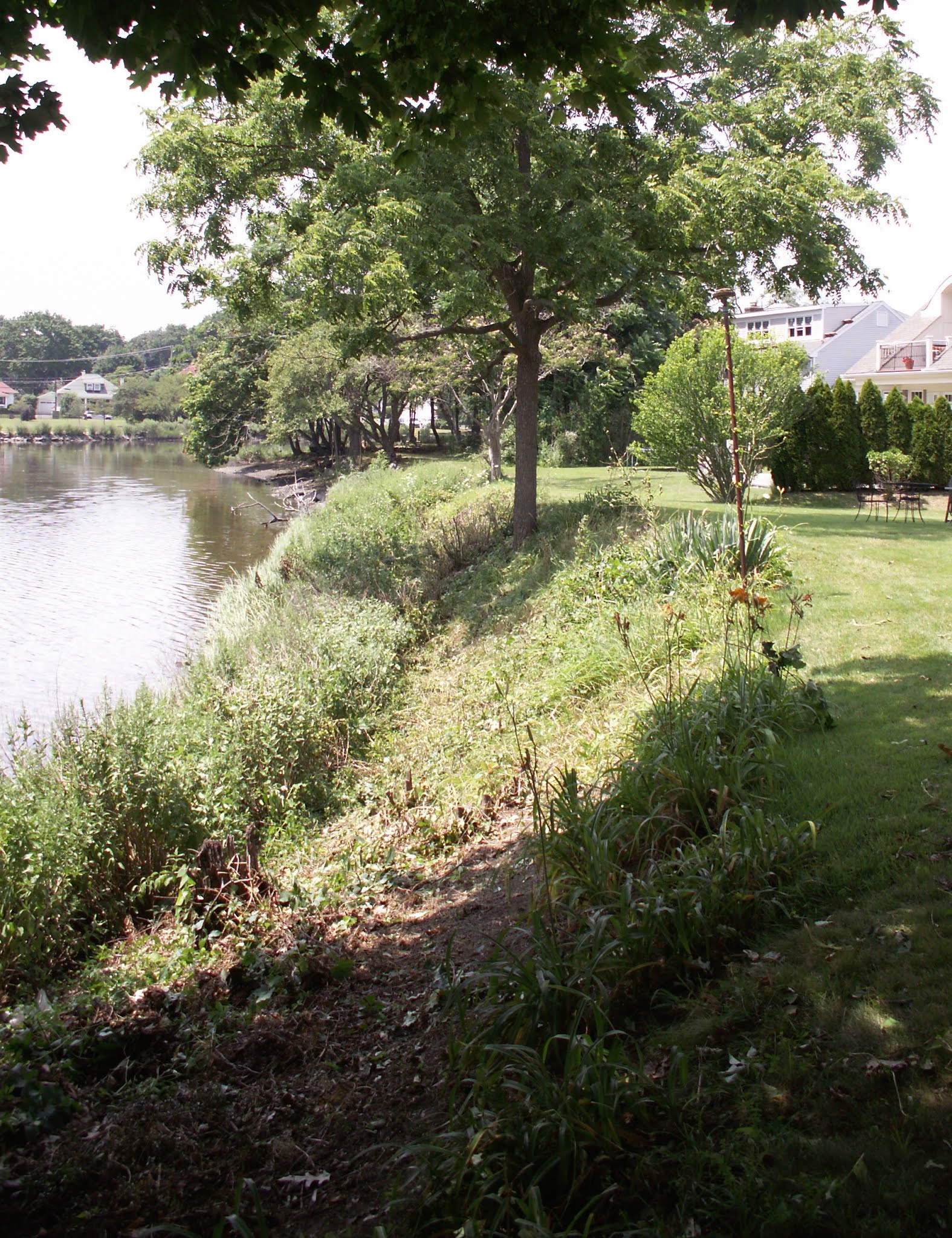
The memorial garden consists of a strip of land ("Right of Way to Cemetery") connecting the Mead Cemetery on the east side of the Cos Cob Mill Pond to the terminus of Relay Place. "This is the same path to and from the cemetery that she would have traversed when visiting the graves of her father, Ebenezer Smith, and her husband, William H. Mead," said Association president, Jeffrey Bingham Mead.

"She died in the home she built and gave to her caretaker, Mary Frances Peck, at 7 Relay Place," Mead continued. "Caroline's funeral was held in the home. Her final journey was from the house to the end of Relay Place, along the path to the cemetery where she was interred in June, 1910. In her recorded last will and testament she hand drew the property lines as they are still today in the 21st century." 

The land -including the cemetery, which was established circa 1791- has been in the family's possession since the late 17th century. It measures approximating one-third of an acre. 

Work on the memorial garden and cemetery was originally scheduled to begin in March, 2020. The COVID-19 pandemic and government-instituted lockdowns at that time delayed the initial start of the project. 

Starting in October, 2020 work resumed and is continuing throughout the winter into Spring, 2021. The Association's goal is to complete most work by May 15, 2021. 

This will include the creation of flower beds along the property lines and shoreline along the Cos Cob Mill Pond; the trimming and removal of some trees, planting of perennial and annual ornamental flowers and the installation of either an arbor or gate at the entrance. 


At the same time, work is being performed on the cemetery. This includes the replacement of sod and invasive vines, removal and trimming of trees, the planting of ground-covers and the cleaning of grave markers. 

Ebenezer Smith, father of Caroline Mills Smith Mead, is interred in the cemetery. 


A long time ago a massive oak tree once graced the landscape in front of the Mead home located where Cos Cob Elementary School is today. 

The drawing featured here is by Whitman Bailey of the "Bill Mead Oak." No one recalls when the tree came down, though it reputedly happened during a hurricane. The tree was so large that a large section of the trunk was hollow, allowing people to actually go inside. 

The date of this drawing, allegedly from a photograph, is 1930.


The William H. Mead House (left), now the site of  Cos Cob Elementary School (right)


The Caroline Mills Smith Mead House, circa 1904, at 391 East Putnam Avenue, Cos Cob.
Today it is the home of Greenwich Dentistry.  

The Caroline Mills Smith Mead Memorial Garden and the Mead Family Cemetery at Cos Cob are not open to the public. 

Escorted visits must be arranged by appointment-only through the Association. 

An application is in the process of submission to have the property listed on the Connecticut State Register of Historic Places. 

The Mead Family Cemetery at Cos Cob is a private family plot with burials restricted to Mead family descendants. 

Contact meadburyinggrounds@gmail.com for further information. 


Greenwich Life As It Is-And Was: Historic Ten Acres and the Grave of Major-General Ebenezer Mead (1921)

 Source: Greenwich News and Graphic, by Erwin Edwards. February 11, 1921. Page 4 and 10.


Ten Acres: Every resident of the Town but the stranger, knows where Ten Acres is. (Note: Ten Acres is now the campus of Greenwich High School off East Putnam Avenue and Hillside Road).

And why shouldn't every resident of the Town but the stranger, knows where Ten Acres is located, that is if a historic plot of land, which is as old as Horseneck, counts for anything in the mind of that resident?

Historic, yes, as historic as Put's Hill; perhaps not so widely known, but the two are always associated together by Greenwich people whenever either is mentioned, for both are connected with the history and life of Greenwich, and admin each other. 

It was across Ten Acres that general Putnam sped after his ride down the steep, now named in his honor, it being a short cut over the meadow to the main road leading to Fort Putnam, three miles away, where Putnam was hastening for reinforcements, after Tryon's raid on Greenwich.

Near the Boston Post road, or as it was called in those days the King's Highway, and on Ten Acres, was the home of a patriot, one who fought in the revolutionary war and attained high rank and one who did much for Greenwich -Major-General Ebenezer Mead.


The house which he occupied, and in the doorway of which he stood when General Putnam Dashed down the hill and cut across the meadow, is still standing and is just beyond the foot of the steep. 

A few years ago there was uncovered at Ten Acres not far from the house and to the west of it, a gravestone which marked the last resting place of General Mead.

How it was uncovered came about in this way: There came to Greenwich some years ago from the west a man whose boyhood days had been spent in Greenwich, by the name of James R. Mead.


After making some inquiries he learned that General Mead was buried at Ten Acres, a fact which he knew, but the exact spot he didn't know.

But he found someone who seemed to know where the grave was supposed to be, and this information was imparted to him.

he gave instructions to a responsible man to find out if the grave of General Mead could positively be proved  to be there. Carefully the underbrush, the earth and the grass, which had accumulated in long years was removed, time having leveled the original mound.

Soon a gravestone was unearthed, which lay flat on the ground, having been beaten to earth by winds and storms. It could be seen that it was cracked across its center width. It was carefully lifted out of its resting place and placed on the ground nearby.

Deftly the clinging dirt and moss was brushed off, and traces were then disclosed of the indentures of an inscription. 

Still more carefully removing the discolorations and the moss, which had adhered to it, then it was that the marks on it were plainly revealed, and the inscription was easily deciphered and read:


Maj-General

EBENEZER MEAD

died Feb. 7, 1818


Yes, that was the grave of General Mead. There was no doubt about it, the gravestone was the proof. The long neglected and almost obliterated resting place of this noted General, this Connecticut soldier, and Greenwich patriot had been found.


The Ebenezer Mead gravestone, relocated many years ago to the cemetery in Christ Church Greenwich. 


There was other wording on this brown gravestone, but only the name and the date could be made out.

The ground was smoothed over and the spot was left undisturbed otherwise. The monument was not taken away, and it is there today, or was, a short time ago, or it may be leaning alongside the near-by stonewall where it was placed.

It was the custom in colonial days, and later, to bury th owner of a farm or an estate, on the premises, usually in the orchard, in a lot back of the house, or by the road-side near the dwelling. And that is how it happened that the grave of General Mead was in Ten Acres, not far from his dwelling.

Just beyond the meadow where this grave is, or rather at the top of Put's Hill, is the large boulder, or monument, placed there in memory of General Putnam and marking the place where he started on his daring ride.

All which explains how that immediate locality has become historic, associated as it is, with great men and colonial life and revolutionary war days.

How Ten Acres came by its name would naturally suggest itself to most anyone. It is a large, level meadow, round in contour and contains just that number of acres, and there is not a tree on the field.

Just north of Ten Acres, West Brothers Brook comes tumbling down over the rocks, at such descent, and in such rapid current, that the water, dashing against the strong obstructions, is churning into foam, which suggested the name, Butter Milk Falls, a name as old as Ten Acres.

West Brothers Brook courses down through the meadow, but originally went its own way. years ago, however, a deep ditch was cut through the center of the field, and the water now flows in this ne channel, continuing its run until it meets its brother, East Brothers Brook, at the side of the Boston Post road, but a short distance beyond.

In the winter, Ten Acres becomes an ice pond, by means of a dam which causes the meadow to be flooded with water.

For years and years, a hundred years, Ten Acres has been a pleasure ground in the winter time. A popular skating pond, known far beyond the confines of Greenwich, and today it is more popular than ever as a pond to indulge in that pastime.

Though Ten Acres may some day be more exclusive than it is under its present owner, for he has never put up a "no trespass" sign, nor does he intend to, but if the public is ever disbarred from it, it will always have its historic associations which never can be taken away from it as long as the history of Greenwich remains.


Friday, January 1, 2021

Another Land Company: Merwin Mead Property (1899)

Source: Greenwich Graphic. April 15, 1899. Page 1.


Building sites in the borough have always been held at a high figure, for the simple reason that the demand was greater than the supply. Many people would have bought and built house, could they have obtained what they wanted at a price within their means. That is the chief reason why the village has failed to grow, in proportion to other towns along the shore. Lots as a rule have been held very high, and this has deterred the man of ordinary means from located here. By ordinary means we refer to a person, say who has an income of two or three thousand dollars.

When it became known that Mr. Merwin Mead had concluded to throw his land upon the market and cut it up into building sites, with one voice, those who heard of it said, "It ought to have been done ten years ago, and what a paying investment it would have proved." Now that he has decided to depose of it in this way, it will be a good thing for him and the others interested in the property, as well as for the borough.

It is hardly a land company that has control of it, in one sense, for he has not sold it, but passed it over to three trustees to develop.

This farming property of Mr. Mead's comprises about 25 acres and is situated between Greenwich and Davis avenues, and is bounded by Smith Mead's farm on the south and East Elm street on the north. He gave a deed this week of it which empowers Nelson B. Mead, Sheldon E. Minor and George Mead to lay out and open the property into building sites and to improve it, the proceeds to be divided in accordance with the interests.

This property will cut up into about 75 good sites, it can be readily seen that they can be sold for a fair figure and turn in a handsome return to those interested.

Work will be begun on the property to improve __________ the change it will _________. Greenwich ______ then ought to grow, and grow rapidly. 

Sunday, December 27, 2020

REAL ESTATE DEVELOPMENT: What Greenwich Offers to Investors in Land (1899)

 Source: Greenwich Graphic. July 22, 1899. Page 1. 

Never before has there been such activity in the development of real estate in Greenwich is now. Those who are skilled readers of the signs of the times say that a big boom in real estate is at hand. And, to judge from appearances, it would seem that they are pretty near the truth. 

Two weeks ago we described Rockridge Farm, showing how these seventy-five acres have been opened up. And no other part of the town has the development of real estate been carried so far as there. But there are several other neighborhoods where a commitment is being made or is contemplated..

North of the Post Road near Chickahominy is the section known as "Belle Aire. This is a large tract of land, and very considerable improvements have been made to render it available for residences. This land is now on the market. It is full of beautiful sites, and when the impending boom strikes us with its full force, they may be expected to sell with quick succession.

South of this district in Chickahominy there is some extremely available land. Nothing has been done so far toward putting it in condition to sell, but we understand the steps will be taken soon in that direction.

It has often been remarked that the property owned by Mr. Smith Mead, on Greenwich Avenue it is, from its location, among the most valuable spots in the town. This is now to be opened up to the public.

The work of development is, we understand, to be superintended by Mr. George Mead, Mr. Nelson B. Mead and Mr. Sheldon E. Minor, the civil engineer. A road will probably be cut through to Railroad avenue and another look connect that with Greenwich avenue at Arch street. The lots ______ into lots of suitable size_____ and will be offered for _____ this work can be accomplished. 

Several weeks ago the ______ the old Sniffen house, on ____ Road, were sold at auction. These lots had been on the market for some time, and, though extremely desireable, had not found purchasers. That they have been recently sold may be regarded as one bit of evidence of the increasing activity in real estate circles here.

During the past few years the property of Mr. W.J. Smith, at Indian Orchard, which is just south of the railroad track and north of Mr. Benedict's place, has been rapidly covered with residences. The lots there are within the reach of people of moderate means, and are still finding a ready market.

Another similar district is that known as meadow Brook Park, owned by H.B. Marshall. This has been cut up into lots for residences, many of which have been sold. A considerable number are now on the market. 

It will be seen that the development of Greenwich for the next few years will be to a great extent the settlement of these districts. The offer opportunities for men of different means. The man with a modest competence can among them find a place within his power to buy. The man of wealth may find spots also to suit his requirements. 

Greenwich real estate is not, however, being developed by districts only. Many men have selected land apart from other dwellings and have built there. These are among the most beautiful places in town. There are too many of them to permit of separate mention now. We have given here only a general outline of the possibilities of real estate development in Greenwich. We expect in the near future to describe at more length some of the localities and places which form a part of the modern growth of the town. 


ROCKRIDGE FARM (1899)

Source: Greenwich Graphic. July 8, 1899. Page 1.


In the earlier days of Greenwich it was said, and justly, too, that amid all the farms of the town, distinguished as they were for fertility and natural beauty, none was superior to, and but few could vie with that known as the Zachias [Zaccheus] Mead farm. Times change and likewise names. The charming strip of land is no longer known as the Zachias  [Zaccheus] Mead Farm. As Rock Ridge Farm it retains those beauties of nature for which it was celebrated, enhanced by the modifying touch of the artist. We have printed in the last year or two numerous pictures and descriptions of those ancient houses, which still stand to remind us of the Greenwich that once was. Not less worthy of description and photographic reproduction in the section now called Rockridge Farm, a section destined to be one of the most popular as it is one of the most beautiful parts of modern Greenwich. 

Rockridge Farm consists of that tongue of land enclosed between the Glenville road and Lake Avenue, at their southern extremities, about 175 acres. The southern and western boundary of the Farm is a road called Brookside Drive, which begins at the residence of Mr. Willis H. Wilcox, on the Post Road, and follows the course of Horseneck Brook north until it meets and unites with the Glenville road. Turning to the west it continues to follow the brook and again turning northward, after a course of perhaps three-quarters of a mile, it enters the Farm at its western gate, at the foot of the steep hill, familiar to all those who have passed over the Glenville road. Brookside Drive, throughout that part of it which passes the Farm and is at the same time a portion of the Glenville road, has been remade by the owner of the Farm, Mr. Nathaniel Witherell, at his own expense. On the right side of the road he has erected a stone wall on his own property, thus enabling the road to be greatly widened. In the broad, smooth highway now extending beside the historic brook it is difficult to recognize the former Glenville road, so frequently complained of for its inconvenient narrowness. The eastern boundary of the Farm, Lake Avenue, is familiar to all residents of Greenwich. 


Between the boundaries lies Rockridge Farm, destined, we believe, to be one of the most popular residence sections of the town. Tucked away as it is amid sloping hills, passing beyond its limits one would hardly suspect its existence. And yet from within there are long vistas of the Sound and typical New England hills to the north and west. The Farm is an ideal spot for a summer residence, being not more than ten minutes drive from the station, and yet possessing all the charms of a truly rural district. 

When Belle Haven was opened some fifteen years ago, it would have been a most sanguine  optimist who would have ventured to say that in so short a space of time another residence district would be a feasible, not to say necessary undertaking. The fact that such has proved the case is a most potent argument of the growth and prosperity of Greenwich, if, indeed, we needed any. It is to meet this requirement that Mr. Witherell has developed Rockridge Farm. The name Farm, rather than Park, was selected not from any idle affection, but because it more truly denotes the nature of the place. Its beauties are natural, not artificial. Whatever the artistic alteration has been made has served the purpose merely of increasing, and not creating, beauty. This quality of the place will doubtless be preserved by the fact that no less than two acres will be sold to anyone one purchaser. By this means an ample lawn is assured  about each residence, and the unpleasant overcrowding, too characteristic of residence parks, is avoided. 

There are three entrances to Rockridge Farm, one at east on Lake Avenue, a second at the south, at the junction of the Glenville Road and Brookside Drive, and the third at the west, where Brookside Drive enters the Farm. At each of these entrances there is a neat triangle of grass, which is to be covered with shrubs and flowering plants. The most beautiful of the entrances and certainly that in the west. There Mr. Witherell has erected an artistic gateway, consisting of two stone pillars. This entrance is shown on our photographic reproduction. It is here that Brookside Drive enters the Farm, and for nearly a quarter of a mile passes through a grove of lofty trees. At the right side of the drive, as you enter, flows Horseneck Brook, whose bed here is very rocky. There are numberless little pools and tiny gushing waterfalls. Between the drive and the brook are many huge stones, among them a large jagged boulder, famous in this neighborhood. 


On the left of the drive, as you go in, there is a sharp slope, also covered with rough rocks, amid which lofty trees rise. This bit of road has been pronounced by some the most beautiful in Greenwich. And whether this extraordinary praise be accorded or not, it must certainly be admitted among the most beautiful. We show in another picture that portion of the road near the large boulder. After emerging from the woods, the drive turns sharply to the east and crosses Horseneck Brook. The bridge is rustic, with railings composed of rough untrimmed pine trunks. A short distance further along the way a lane turns off to the north. This is the well-known Woodchuck Lane, whose beauties are said to have been highly appreciated by romantic couples for many years back. 

Through the southern entrance to the Farm the road passes through open country, running nearly do north, and winding in graceful curves about the foot of round hills. Throughout the length of this drive one has only to look to the south to see the village and Belle Haven, the waters of the Sound, and the blue coast of Long Island. The eastern entrance on Lake Avenue opens onto that part of the Zachias [Zaccheus] Mead property which was earliest developed. The road runs nearly eastward. Less wild in its natural surroundings and than the western drive, it more nearly resembles the New England country road as we know it in its best form. There are several old houses on this road. Among them is the old Zachias  [Zaccheus] Mead farmhouse. Immediately to the west of the farmhouse is a triangle where the three drives meet. This is practically the center of Rockridge Farm.

One only has to imagine three long winding arms extending from a center to comprehend the construction of the Farm. By the system of roads, the most attractive sites have been made available. It is estimated that the total length of the drives throughout the Farm is between two and three miles.

Some idea of the extent of the Farm, and its distance from the village, may be obtained from the fact that you can start at the Lenox House, driving at an easy pace, enter the Farm at the west gate make a tour of the Farm and arrive at the Lenox House in about an hour. Many of our townspeople have already taken advantage of this drive, which is of a convenient length for the late afternoon and early evening. Indeed, if a stranger has but an hour or two in which to drive about town, he cannot do better than to pass over this course. He will go through as much beautiful country as possible in an hour, and besides will get a view of the Sound, part of the village and Belle Haven.

There are at present six houses in the Farm, occupied respectively by Mrs. Cordes, Mr. Charles Lanier, Mr. E.L. Stabler, Mr. F.W. Ritter, Mr. Barrett, the superintendent of the Farm, and Miss Brown. Two houses are in the process of construction. These houses have the double advantage of being in a situation and surroundings, true country dwellings of an ideal sort and, at the same time, having the modern conveniences of less rural park dwellings. The pipes of the Greenwich Water Company pass through the Farm, and thus a supply of the best water is assured. Moreover, the Borough of Greenwich is constructing a sewer, with which the Farm, which is just beyond the borough limits, may connect. The Farm is lighted by the incandescent electric light, which Mr. Witherell has put in at his own expense. In this way those appliances of sanitation and convenience which are most essential are provided.

Rockridge Farm certainly fulfills what we understood it to have been Mr. Witherell's hope and expectation in regard to was not intended to be a place for display of magnificence. It was intended for a convenient and artistically developed location for country homes, a place where one could have at the same time the conveniences of more thickly  districts and the freedom and ____ of the country. Such is undeniably ___district devoted to country homes should be and it is an artistic development along these lines that is to be desired and expected. The signs at each of the entrances show with the place really is. They announce the name "Rockridge Farm" and beneath that the fact that "visitors are welcome." It is really a huge private country place, a place to be devoted to a number of families; a private place, but at the same time a place whose beauties the public is invited to enter and enjoy. As one passes through the grove and hears the gurgling and babbling of the brook, as one looks out over the field of rye and hears the song of the lark and the thrush, it is hard to realize that one is at the same time amid the comfort and convenience of a truly modern civilization. 

It is in such a way as this that we look for the for the further  development of Greenwich. No town along the Sound offers as admirable opportunities for such development. We are  confident that the time is not far distant when Greenwich will merit to the fullest degree the name which it has already earned, "The ideal suburban town."