Source: Greenwich Graphic. April 13, 1901.
Mr. Seaman Mott Mead, of Greenwich, and Miss Edith Vaughn Parker, daughter of Mr. and Mrs. _____ Parker, were married at the home of the bride, "Shady Cliff," at Hawthorne, Wednesday afternoon, at _____ o'clock. The ceremony was performed by the Rev. J.H. Selden, pastor of the Congregational Church, Greenwich.
The bride wore beautiful white satin dress trimmed with Irish ____ and she carried a bouquet of white ______ and lilies of the valley.
The bridesmaids were Miss Cordelia Willis Mead, of Greenwich, and Miss May Cornell, of Brewster, N.Y. Their gowns were pink crepe de ch___ and they carried shower bouquets of white roses.
Miss Catherine Vaughn, of _____lvn, N.Y., was maid of honor, and she wore a dress of white organdie and she carried a basket of white roses and lilies of the valley.
Mr. Preston Parker, brother of the bride, was groomsman.
The house was beautifully decorated with flowers and palms and _____ted plants.
After the wedding supper, ____ was enjoyed by about ninety _____. Mr. and Mrs. Mead left for a short riding tour, and when they return they will make their home in Greenwich.
Welcome to our news and history blog!

Saturday, November 14, 2015

Ephraim Mead's House: First Brick House in Greenwich, Circa 1830
Source: Greenwich Graphic. October 17, 1913, Page 1.
 |
| Illustration from S.P. Mead's History and Genealogy of the Mead Family. |
WAS FAMOUS OLD HOUSE
STOOD ON INDIAN FIELD
First Brick House Built in Greenwich-Erected 1830, Torn Down in 1895-Pres. Truedale's House Close to Site
Some one remarked to us the other day in speaking of the houses of Greenwich, the beautiful homes and residences, how few of them were built of brick, and the question came up, when was brick first used in Greenwich, and where was the first residence located.
The home of President W. H. Truesdale, of the Lackawanna railroad, known as the road of anthracite and Phoebe Snow, stands on the site or very close to it of the first brick house in Greenwich.
The brick used in its construction came from Holland. Just think of it, bringing brick from Holland. The reason was they could be bought cheaper and brought to this country at less expense then they could be obtained here.
The house stood opposite the Mianus river, some quarter of a mile away from it, and that was all a big farm and this was the only house in that locality.
President Truesdale's house, which is on the site or near it, is at the east end of Bruce Park and about a quarter about a mile from the Cos Cob station. The house was built in 1830, by Ephraim Mead, and was considered one of the places of Greenwich, and was the talk of the community. Farmers from all over town and Stamford and Port Chester came to look at it. It was delightfully located, as so many of the old farm houses in Greenwich were, near the water, with wooded fields and meadow lands of many acres.
The brick house was erected near an old Colonial dwelling, which was built before the Revolutionary War and had a history. This old house which gave way to the new and modern brick one, representing as they did the old and the new, was occupied by Ephram Mead's father, Deliverance Mead, who lived in it during the Revolutionary War. He had been a soldier in the French and Indian wars and saw severe service. In fact his exposure and privations made him so sick that he was incapacitated from further military duty. He was only one of many who gave their lives in defense of their convictions, which brought them here as colonists.
The old house was attacked many times and pillaged by Tories and Cowboys. About the only way the family succeeded in maintaining their existence was to hide their ham and potatoes under the barn door, and make ____ to their ____ at night when they could not be seen by spying eyes.
The valuables that the family possessed, and those were few of course, were hided under a pile of oysters and clams shells, for in those days oysters and clams were principal articles of food outside of ham and potatoes and there were great piles of oyster and clamshells about all these houses along the Sound.
Ephram Mead, who lived in the brick house and built it, left one son and several daughters. The son was Isaac H. Mead, who acquired the interest of his sisters in the farm and became the sole owner. He left a number of sons, among them Ephram T. Mead and Amos H. Mead, well known residents of Greenwich, Dr. Clarkson S. Mead of Port Chester, Willard H. Mead of Wolcott, Wyoming, and Spencer P. Mead of New York, the author of 'Ye History of Greenwich,' which was published recently and which is said to be one of the best gifted local histories published in this country.
This famous brick house was torn down in 1895 to give way to President Truesdale's handsome country home. The bricks that were in this first house built in Greenwich were not thrown away or discarded, but were used again and composed the front of a business building on Railroad Avenue, now owned by Rudolph Bolte. Thus you have the history of the first brick house in Greenwich.
The brick house was erected near an old Colonial dwelling, which was built before the Revolutionary War and had a history. This old house which gave way to the new and modern brick one, representing as they did the old and the new, was occupied by Ephram Mead's father, Deliverance Mead, who lived in it during the Revolutionary War. He had been a soldier in the French and Indian wars and saw severe service. In fact his exposure and privations made him so sick that he was incapacitated from further military duty. He was only one of many who gave their lives in defense of their convictions, which brought them here as colonists.
The old house was attacked many times and pillaged by Tories and Cowboys. About the only way the family succeeded in maintaining their existence was to hide their ham and potatoes under the barn door, and make ____ to their ____ at night when they could not be seen by spying eyes.
The valuables that the family possessed, and those were few of course, were hided under a pile of oysters and clams shells, for in those days oysters and clams were principal articles of food outside of ham and potatoes and there were great piles of oyster and clamshells about all these houses along the Sound.
Ephram Mead, who lived in the brick house and built it, left one son and several daughters. The son was Isaac H. Mead, who acquired the interest of his sisters in the farm and became the sole owner. He left a number of sons, among them Ephram T. Mead and Amos H. Mead, well known residents of Greenwich, Dr. Clarkson S. Mead of Port Chester, Willard H. Mead of Wolcott, Wyoming, and Spencer P. Mead of New York, the author of 'Ye History of Greenwich,' which was published recently and which is said to be one of the best gifted local histories published in this country.
This famous brick house was torn down in 1895 to give way to President Truesdale's handsome country home. The bricks that were in this first house built in Greenwich were not thrown away or discarded, but were used again and composed the front of a business building on Railroad Avenue, now owned by Rudolph Bolte. Thus you have the history of the first brick house in Greenwich.
Thursday, November 12, 2015
Update: Mead Family Burying Ground at North Greenwich November 4, 2015
The following images were recorded on November 4, 2015. The grass at this family burying ground site off Cliffdale Road was cut on that unseasonably warm day. Fortunately for us that made the process that much easier. The job took almost two hours to complete.


Though it is difficult to discern them in this image, a series of small hedge bushes were planted to the left of the gate above. This is the one section of the perimeter of the site that has been wide open.


This is the view from the front of the cemetery facing towards Cliffdale Road. You can see in the distance and through the trees the house directly across the street.
Sunday, November 1, 2015
New Road to New Lebanon (Milo Mead, 1899)
Source: Greenwich Graphic. September 23, 1899. Page 1 and 8.

Milo Mead, the sage of New Lebanon, and one of the most public spirited in the town-would that we had many more such, will ask the town to construct a road from Greenwich to New Lebanon, he, to survey the road and give all the land on his property through which it passes.
If Mr. Mead was a real estate agent or a schemer in the land business, it would be inferred that this was one of those jobs, sometimes rushed through at town meetings, whereby an individual gets a road made through his property, which benefits chiefly himself, and the town pays for it.

Mr. Milo Mead is not that kind of a man. He takes great pride in New Lebanon, and anything that he considers will benefit property in that locality, if it is possible, the project is carried through. Mr. Mead is not a drone, neither does he travel in a stage coach, the trolley suits him, he lets others stick to the ideas of one hundred years ago. One has only to go to New Lebanon and Byram shore and see what he has done for that section of the town and the conclusion is forced upon him that Mr. Mead is no fossil.

They say down there that he sleeps half of the night, and the other half lies awake thinking of what he can do to boom New Lebanon.
About this new road, there is a map of it on the last page, which will give a pretty good idea of where it is located and the connections it makes with existing roads.
It starts about in front of the farmhouse at Mr. John Voorhis' quarry. The route has been surveyed and the stakes indicate where the course of the road is.
It runs through the land of Underhill Lyon a distance of ____ feet, through land of Thomas Ritch 433 feet, through land of Milo Mead 636 feet and Deborah Mead 433 feet.Mr. Mead will give the land through his property and Deborah Mead all do so also. Making a distance of 1091 feet which is about half the distance. Whether Mr. Lyon or Mr. Ritch will do likewise is not known, for they are non-committal on the subject.
Mr. Milo Mead has no interest in this project other than a public spirited one. He says it will help his property some, but it will greatly benefit New Lebanon and Byram shore, for it will bring them in close touch with Greenwich, and shorten the distance, more than one half, than by the Post Road. It would make another of those Charming drives, away from the main road, for which Greenwich is famous.
The total length of the road is 2,307 feet, not quite a half a mile. Mr. Mead estimates that it would cost about $2000 to build it, and this includes buying the land through the property of Underhill Lyon and Thomas Ritch if they should demand payment for it.
The matter will come before the annual town meeting Monday, October 2, when the subject will be fully discussed, and it is hoped that Mr. Mead's proposal will be accepted.

MILO MEAD'S PROPOSITION TO THE TOWN
The Route Surveyed-Mr. Mead Offers Land for More than Half the Way-Road Starts at Voorhis' Quarry and Runs to Byram Road-Distance 2,307 feet-The matter Comes Up at Town Meeting.
Milo Mead, the sage of New Lebanon, and one of the most public spirited in the town-would that we had many more such, will ask the town to construct a road from Greenwich to New Lebanon, he, to survey the road and give all the land on his property through which it passes.
If Mr. Mead was a real estate agent or a schemer in the land business, it would be inferred that this was one of those jobs, sometimes rushed through at town meetings, whereby an individual gets a road made through his property, which benefits chiefly himself, and the town pays for it.

Mr. Milo Mead is not that kind of a man. He takes great pride in New Lebanon, and anything that he considers will benefit property in that locality, if it is possible, the project is carried through. Mr. Mead is not a drone, neither does he travel in a stage coach, the trolley suits him, he lets others stick to the ideas of one hundred years ago. One has only to go to New Lebanon and Byram shore and see what he has done for that section of the town and the conclusion is forced upon him that Mr. Mead is no fossil.

They say down there that he sleeps half of the night, and the other half lies awake thinking of what he can do to boom New Lebanon.
About this new road, there is a map of it on the last page, which will give a pretty good idea of where it is located and the connections it makes with existing roads.
It starts about in front of the farmhouse at Mr. John Voorhis' quarry. The route has been surveyed and the stakes indicate where the course of the road is.
It runs through the land of Underhill Lyon a distance of ____ feet, through land of Thomas Ritch 433 feet, through land of Milo Mead 636 feet and Deborah Mead 433 feet.Mr. Mead will give the land through his property and Deborah Mead all do so also. Making a distance of 1091 feet which is about half the distance. Whether Mr. Lyon or Mr. Ritch will do likewise is not known, for they are non-committal on the subject.
Mr. Milo Mead has no interest in this project other than a public spirited one. He says it will help his property some, but it will greatly benefit New Lebanon and Byram shore, for it will bring them in close touch with Greenwich, and shorten the distance, more than one half, than by the Post Road. It would make another of those Charming drives, away from the main road, for which Greenwich is famous.
The total length of the road is 2,307 feet, not quite a half a mile. Mr. Mead estimates that it would cost about $2000 to build it, and this includes buying the land through the property of Underhill Lyon and Thomas Ritch if they should demand payment for it.
The matter will come before the annual town meeting Monday, October 2, when the subject will be fully discussed, and it is hoped that Mr. Mead's proposal will be accepted.
Apples and Cows (Milo Mead, 1899)
Source: Greenwich Graphic. December 30, 1899. Page 1.
NEW LEBANON, CONN. Dec. 25, 1899.
Editor of the Graphic:
There was a statement in the Greenwich News, alias the "Greenwich History," about eight or ten weeks ago, that the cattle in different parts of this town and become drunk by the effect of eating so many apples. That was not the drunkenness of intoxication but of sickness. The apples acted as a cathartic and educed their strength which made them stagger. If a person should drink a quart of sweet cider at once it would make him sick, and he might stagger if he attempted to walk, though he would ______ or guise his family.
Farmers say that the eating apples dries up the milk ____ milk cows. That need not be so if cows are fed a reasonable quantity of apples with hay, say half a bushel at a feeding, twice a day. The apples will increase the quantity of milk and have no injurious effect, except, perhaps, they may choke, the cows, but if they are fed in a manger in a stable, that will seldom happen. If the apples are poured on the ground the master cows will chase the others, and in their eagerness to get the apples they will crowd several into their mouths before they are chewed, and thereby be choked.
MILO MEAD
NEW LEBANON, CONN. Dec. 25, 1899.
Editor of the Graphic:
There was a statement in the Greenwich News, alias the "Greenwich History," about eight or ten weeks ago, that the cattle in different parts of this town and become drunk by the effect of eating so many apples. That was not the drunkenness of intoxication but of sickness. The apples acted as a cathartic and educed their strength which made them stagger. If a person should drink a quart of sweet cider at once it would make him sick, and he might stagger if he attempted to walk, though he would ______ or guise his family.
Farmers say that the eating apples dries up the milk ____ milk cows. That need not be so if cows are fed a reasonable quantity of apples with hay, say half a bushel at a feeding, twice a day. The apples will increase the quantity of milk and have no injurious effect, except, perhaps, they may choke, the cows, but if they are fed in a manger in a stable, that will seldom happen. If the apples are poured on the ground the master cows will chase the others, and in their eagerness to get the apples they will crowd several into their mouths before they are chewed, and thereby be choked.
MILO MEAD
Original Maps: Putnam Cemetery, Greenwich
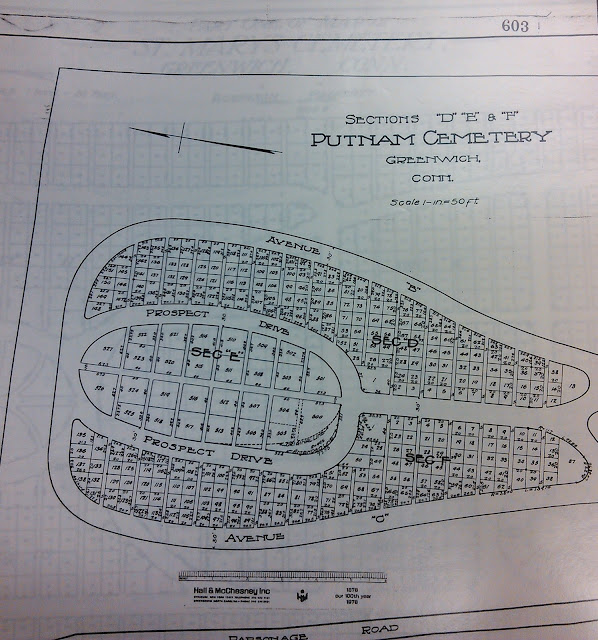
On a recent trip to Greenwich Town Hall we came upon these maps of Putnam Cemetery. Located in the vault of the Town Clerk's Office, these maps show the laying out of grave plots when this cemetery was created and opened in the late 19th century.
A number of small family plots in Greenwich were removed and relocated here. You can find these and other graves in the center section as one drives into the cemetery from the Parsonage Road entrance.

A number of small family plots in Greenwich were removed and relocated here. You can find these and other graves in the center section as one drives into the cemetery from the Parsonage Road entrance.


Subscribe to:
Posts (Atom)