Welcome to our news and history blog!

Welcome to our news and history blog!

Friday, December 18, 2015

It Was Well Known in '76. The Old House at Indian Field Road. (1898)

Source: Greenwich Graphic. June 11, 1898. Page 1.

Hessians, British, Tories and Continental Soldiers, Occupied it at Various Times-The property Has Always Been in the Same Family.


It looks old, dilapidated, deserted and forgotten; but hardly forgotten, for every old resident of Greenwich knows the house, and has heard the tales of how it stood there during the Revolutionary War. To-day it connects the old with the new; the past with the present; the early struggles of the colonies and the founders of the Union with the civilization of our times. Most forcibly does this old dwelling illustrate, standing there alone, with beautiful mansions nearby, filled wit every comfort that money can suggest, the growth and prosperity of the country covering a period of over 200 years.

Where does the house stand? Everybody in town knows that is on the what is now called Charles Mead's Point or what was known in the days of the Revolution...

...from the "red face" is still in possession of the family. The children of Judge Whitman S. Mead, who now reside there, are rthe seventh generation who have been born on the property.

A log cabin was first erected on this site, but about 150 years ago this dwelling house was erected. About 50 years ago it was vacated, and the homestead just east of it and near the water was built.

This property passed from John Mead, who owned it in 1686, to Ebenezer, to Ebenezer, 2d, to Jonas, to Jonas, 2d, to Charles Mead, who died, at an advanced age, a few years ago. At present the house is occupied by his children.

The old house belonged to anybody and everybody almost, during the Revolutionary War.

At that period is was the home of Jonas Mead. The times here hard, and he was so annoyed by the Tories and British that he was obliged to vacate it. It was raided by Hessians, Tories, Cowboysd and Continentals, and had been used as headquarters at various times by the solders of both armies. It was so situated as to be an object of contention. It was stripped of pretty much everything it contained except what was in one room, which was afterward known as the second secret chamber.

This room was not the result of design on the part of the builders, but developed by the swinging of a door. It was off the kitchen, but access was contained to it through a doorway at the foot of the stairs. The kitchen door swung in such a way as to conceal the door leading to this little room, sand the marauders never suspected the existence of such a chamber.

When the family returned after the war they found everything in this part of the house just as they left it. 

It was built of big beams, as was the custom in those days. One of the braces was too long and was chopped off with an ax. This ragged end always remained sticking out beyond the others and was conspicuous. The original siding was split from a log and shaved with a drawing knife.

This plot of land on which the old house is situated was considered one of the finest along the shore, and a favorite place for Indians to gather. It was called Indian Field to designate it from Horseneck Field, which is the part of land where Belle Haven is now located.

When Greenwich was deeded to the white settlers by the Indians, they reserved 125 acres on the shore for themselves and Indian Field was the spot bordering the shore. 

The Indians had seen the white people make stone walls to divide their property and so they thought they would separate their land from the settlers by such a barrier.

The had neither horses or oxen to work with, and the knew as much about making a stone wall as a cow does about handling a musket. They rolled stones for awhile and piled them up for a short distance, but they soon became very tired and gave up stone-wall building. This boundary mark they intended to stretch across from Indian Harbor to the Mianus river. The point where they commenced to build is nearly opposite the Held House, and the stones are still there, piled up Indian fashion, and remain a monument to this day to their engineering skills in wall constructing.

In conversation with the late Charles Mead one day not long ago before he died, he said that while there have been many things raised on the farm, it had never raised a mortgage. This is perhaps the most remarkable things that can be said in connection with this famous spot.

Near where the present residence now stands, the home of Judge Whitman S. Mead, is a field which has always been known to the family as the Wigwam. 

It is said that this hose was built of brick so that it could not be bombarded and set on fire, for in the War of 1812 houses along the shore of the Sound got a raking once or twice, and we are told that this one dwelling we have described was the target of a British frigate in those days.

So the old house has its history, which like the ivy and Virginia Creeper clings about it, and makes it picturesque and interesting, but not forgotten, even though old and crumbling. The moss is thick under its eaves, and on its weather-stained shingles, and the swallows have taken undisputed possession of it, but while apparently neglected it is still in the public eye. 


Mr. Mead's Embalming Fluid: In a Famous Case in Court (1892)

Source: Greenwich Graphic. Saturday, January 30, 1892. Page 3.


Undertaker I.L. Mead's embalming fluid played an important part at the trial of Carlyle W. Harris on Wednesday last, charged with killing his wife Helen N. Potts, now occupying the attention of the Court of General Session New York.

The defense set up a claim that the fluid contained morphine and that the poison found in the body of Mr. Harris was that from the embalming fluid.

Professor Witthaus, the most noted chemist of the day testified that he made an analysis of Mr. Mead's fluid and found no morphine of quinine, that the ingredients were harmless in themselves and in no way should it be charged that the morphine found came from the fluid. 


Professor Witthaus testified that he made an analysis of a quantity of Mead's embalming fluid, which he received from undertaker Vannett, and which the latter told him was taken from the same bottle as contained that used in embalming Mrs. Pott's body. In answer to Assistant District Attorney Wellman, Dr. Witthaus stated that in his examination of the fluid he found no morphine or quinine. 

Counsel for the defense objected to the introduction of the testimony on the grounds that it was not proved that the portion of the fluid which the witness analyzed was the same as that used in embalming Miss Potts's body. The objection was overruled. 

Mr. Jerome in his cross examination of Dr. Witthaus, quoted largely from Professor Wormley's work on "Micro-Chemistry of Poisons." Dr. Wittlaus agreed largely with Professor Wormley. 


Friday, December 11, 2015

Houses With Histories: Linked With Them Tales of the Revolution (North Greenwich, 1897)

Source: Greenwich Graphic. Saturday, October 23, 1897. Page 1.


There are many old houses in Greenwich. So old are some of them that two centuries and more have gone since the moss began to grow upon their hand-cut shingles, and under the eaves, and the wind and sun touched them with the hand of time, those indisputable marks of age.

Some of these old dwellings, could they speak, would tell of scenes which took place within their doors, or on the meadows nearby, of the Revolutionary War. Would point to the marks of Washington's spurs on some door or stairway, or tell what took place within their rooms when Genera Putnam shook his fist at a Tory or danced with a Greenwich belle.


The Solomon S. Mead homestead, reportedly purchased by Dr. Fred Hyde, is located at a point in Greenwich exactly six miles from the railroad stations at Port Chester, White Plains and Greenwich. 

The dwelling occupies the site of one erected by Benjamin Mead in 1673. The old well near the back door was dug by the same ancestor, who was a direct descendant of the original John Mead.

The present dwelling, with its quaint ____, its sloping, moss grown roof, and its latticed windows was the creation of a second Benjamin Mead, and dates from 1793.


There is stands, to-day, well down to the sod, how studied and rambling, with the mammoth chimney and its colonial doors, a true type of a homestead of a century ago. 

Within are great rooms with exquisite paneling of ancient pattern, and great beams overhead and down the corners of the rooms.

The fireplaces are broad and deep, and hold heat logs five feet long, while the mantels are white with delicate panels, and a tracery of vines that give grace and beauty to their angular structure. The stairs are broad and the treads are low, with a black walnut hand rail on one side. The sleeping rooms are large and low studded with many closets, some high in the room and some down to the floor, but all with little brass knobs and great brass hinges. About these rooms are displayed pieces of antique furniture, rich and rare, that are older than the house, and are a century and a hand old and more. There are settees and spinels and warming pans. Canopied beds and covered with white lace, and the sofa, tables and elegant sideboard stand in ________ crook and end in ferocious _____.


With ______ use is just what is outward ________ indicates -a home of wealth and culture, modeled after the _____ home of a century ago.

Here were born Obadiah, Mary. The twins Anna and Phebe.

The family lived in the turbulent times of the Revolutionary war. They were ____ _____ and refinement, and _____ ____ to the American cause, stood _____ the cowboys and Tories and he ___, like methods of these encounters. 

The 130 acres about the homestead were planted with wheat and corn, and on one occasion were the subject of a British war ships in the Sound.


The children were well grown then, with the exception of little Anna and Phebe, who hid with their mother in the cellar of the old house as the redcoats marched up the road.

The father and the older girls barricaded the doors and windows, while Obadiah, the only son, solicitous for the flocks without, corralled them in the yard, then beat a hasty retreat t a neighbor's barn.

An unfriendly Tory, knowing the fact, informed the British soldiers, who surrounded the barn, threatening to set fire to it unless he came out. He, too brave to surrender, leaped from the barn and ran across the orchard towards the rocks, above "Dyspepsia Lane." But the British followed, and seeing that escape was impossible, Obadiah surrendered, only to be immediately fired at and instantly killed.

The ball passed through his left arm and entered his side. For several generations the place of his burial was a sacred spot to the members of the family, and now, though unknown, is not forgotten in memory. 


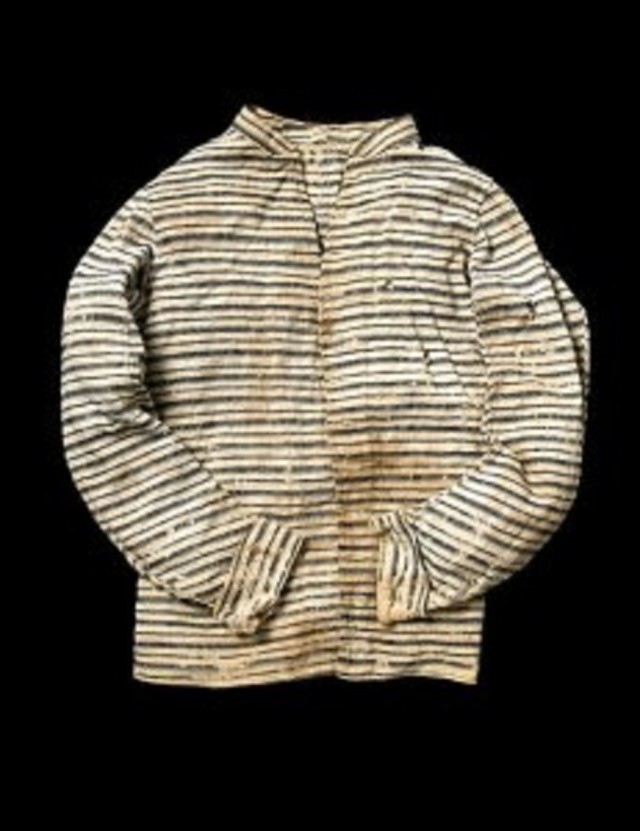
The coat he wore, showing the bullet holes and bloodstains, has been preserved all these years, and is now owned by Solomon S. Mead. After killing the only son, the red coats forced their way into the house, but unable to find the father, they departed, taking with them the horse and all the geese.

The house has for many years been famous as a place for summer boarders who passed the leisure of July and August days beneath the shade of ancient trees and waxed fat at the plentiful table of Farmer Mead. But in 1896 Mr. Mead sold the old place to his cousin, Dr. Hyde, also a lineal descendant of Benjamin Mead. While the present owner has spent a large amount of money improving the place, he has shown his wisdom and good taste in preserving the lines of the ancient house. 

Tuesday, December 8, 2015

'TWAS CALLED "DEARFIELD" (1897)

Source: Greenwich Graphic. Saturday, December 4, 1897. Page 1.


The Col. Thomas A. Mead Homestead-A Colonial Dwelling.

The ancient dwelling and the old button ball tree, do you know them? Of course you do or you haven't lived in Greenwich a great while.

The house is spoken of as the old Colonial Thomas A. Mead homestead, and its hospitable doors have opened and shut for one hundred years to members of this Mead family and their friends, and the stranger is often sheltered there.


And what a grand old dwelling it is, at once suggestive of refinement, quiet and comfort. Nowadays such houses are fashionable, and they call them colonial, but, as usual the imitation has not the beauty in any respect of the original.

Dr. Amos Mead, who built the house, was the father of Col. Thomas A. Mead, and it is the homestead of this branch of the Meads.

When Richard Mead was about to take to himself a Colonial dame to share his lot, his father, the doctor, built this house and gave it to him, as a wedding gift. It was called "Dearfield," the dear spelled with an a and not two e's. It was built in 1797, so the knocker on the door says, and cast a "pile" of money for those days, and its frame went abroad for miles around as being a great and magnificent home, and one of the sights of the times.


The old brass knocker on the front door still holds its place as of old, although there was a brief season when it was relegated to the garret because the door bell had pushed it aside, but 'twas only for a time, for Miss Lucinda Mead, while rummaging in that top room, discovered it on its resting place, a beam, where it had grown green with verdigris, and took it down, polished it to its former brightness, and put it back on its old friend, the door, where it has remained ever since, admired by all lovers of things antique, and readily seen from the street by the passerby.

When Richard Mead died the house came into the possession of the son, Col. Thomas A. Mead, who was in his day one of the prominent citizens of Greenwich, sturdy, staunch, and true, a type of the men who made New England famous and America what it is to-day. Col. Mead, during the last few years of his life, used to be fond of sitting on the pitch near the front door and watching the boats on the Sound. He loved that beautiful marine view. And it certainly is one of the most charming pictures to be found anywhere.

One day Wm. M. Tweed sent word to the Colonel that he would like to buy the lot in front of his house, and asked him his price. "I have no price," said the Colonel. "Go back and tell Mr. Tweed that I don't care to put my eyes out. No, no, tell Mr. Tweed I don't care to sell it. It's worth more to me than money." And on the long summer afternoons, only a few years ago, he used to sit there, "All the landscape like a page perusing." The house is now occupied by a daughter, a grand-daughter and a daughter-in-law of Col. Mead.


The immense button ball tree, which stands directly in front of the house is a landmark. We doubt if there is another tree of this kind in the State of its size, and don't dare to say what its diameter or circumference is near the ground. As it stands in the picture, but a faint idea of its proportions can be discerned. he captain of every Sound steamer knows it, and oystermen use it as a mark to find their grounds. It was planted about 1700, so that it is nearly two hundred years old.

When Gen. Lafayette passed through Greenwich in 1824, and was given a reception at Put's hill, he stopped, it is said, at the top of the hill in front of Colonel Thomas Mead's and alighting from his carriage, shook hands with a number of people who were there awaiting his arrival in town beneath this grand tree.

The top of the old landmark is gone, it was used for firewood in the days when the British red coast chased Put down the hill. Coal they did not have in those days.

It had been a snowy week, and the wood pile had disappeared. Danger lurked on every side, it was not possible to go to the woods to replenish the fuel and so the top of the button ball was cut off to be used for firewood.

Will the two rather the storms of another one hundred years, will changes be made as great around them as have taken place in the century just passed?


"The Old Man" by M. Mead (1890)

Source: Greenwich Graphic. Saturday, March 1, 1890. Page 3


Young Woman's Christian Temperance Union Discontinued (1890)

Source: Greenwich Graphic. Saturday, March 15, 1890. Page 3


Pres. Dole [of Hawaii] and Greenwich: Has Many Friends Here-He Spent Two Years at Round Hill (1898)

Source: Greenwich Graphic. Saturday, January 2, 1898. Page 1.


President Dole, of the Sandwich Islands, the man who is doing more to bring about the annexation of these Islands to the United States than any other one person, is now in Washington. He has just arrived from these Islands of the Pacific. He is here now in the interest of annexation.

He has made himself conspicuous throughout the world by the able manner in which he has carried the Islands through the great difficulties of a change of government.

Of course Greenwich people are interested in him. Why should't they be? His name is Sanford B. Dole, and he was called Sanford out of respect to Sanford Mead.

He was born in 1847 in Hawaii and is the son of Daniel Dole and Emily Ballard, both being natives of Maine. Daniel Dole went to the Sandwich Islands in 1832 as a missionary. His wife died there in 1849, and he married Miss Charlotte Close Knapp Dole, who had gone to the Islands as a teacher, and who was a daughter of Gilbert Close, of Stanwich. Sanford B. Dole really knew no other mother than the second wife of his father.

Rev. Daniel Dole, and his second wife Charlotte Close Knapp Dole, formerly of Greenwich. 

President Dole began his studies in the Sandwich Islands and completed his education in this country. He came to the United States in 1860, when he was 22 years of age, and made his home with Isaac O. Close and wife at Round Hill for two years, and then went to Williams College, from which he was graduated.

He read law in Boston and returned to the Sandwich Islands in 1871. 

In 1873 he married Miss Annie Kate, a young lady from Maine. He met Miss Kate in the Sandwich Islands, where she was visiting, but was married in Maine. Twice since that time he has visited he United States, the last time in 1891.

He practiced law in the Islands and occupied, before he became President, very important positions of trust.

President Dole is a tall man, a little over six feet in height, wears a full beard and weighs about 180 pounds. His presence is dignified and commanding.

He is quite well known in Greenwich, and was the guest in 1891 of the late Charles Mead at Charles Mead Point.

It is hoped that he will not forget that Greenwich is but a short distance from Washington. He would receive a cordial welcome from our townspeople.