Welcome to the online news and history blog of Historic Mead Burying Grounds, Inc., Greenwich Connecticut USA
Welcome to our news and history blog!
Thursday, August 26, 2010
A Mystery Solved: Disinterments at the Cos Cob Family Plot

Back to Historical Blogging!
I also had some 35mm slides scanned which relate to the family cemeteries. These will be posted with historical commentary in the days ahead.
It's nice to be back. Cheers!
Historically yours,
Jeffrey Bingham Mead
Friday, July 16, 2010
Gravestone Motifs: Weeping Willows and Urns
In the 1980s I wrote a local history column that appeared in the Greenwich Time newspaper. I was a member of its Board of Contributors in those fun-filled days when I also served on the board of the Greenwich Historical Society.
Last night I was inspecting my files of old published articles from my column when I found one that focused on the motifs and iconography carved on gravestones. “The motifs found on a number of gravestones throughout the burying grounds of Greenwich have withstood most of the effects of the elements, leaving meanings and significance for us to ponder,” I quote from ‘Unlocking the Secrets of the Past.’
Perhaps the best-known proponent of analysis and study of New England’s ancient burying grounds was the late Harriette Merrifield Forbes. “To interpret them properly it is necessary to close our 20th century eyes and look at them with the eyes of the past. Thus we can appreciate the beauty and craftsmanship of those designs and perhaps find a lesson for ourselves in a few of them at least.”
I think anyone walking through the cemeteries and burying grounds today would notice the carved weeping willow trees that appear on 19th century marble stones. This motif started to appear on gravestone markers in the early 1800s. Often the weeping willow tree stood alone or with an urn to its side. The Greeks and Romans to store cremated ashes utilized urns. Their appearance also reflected a renewed interest in ancient Greek and Roman architectural styles that also found their ways on to home and government buildings built in the early 19th century.
The most significant feature of live weeping willows we see on today’s landscapes and the carved examples on marble gravestones are the drooping branches. The image conveyed a sense of mourning and sadness felt by the living as a special loved one was laid to eternal rest.
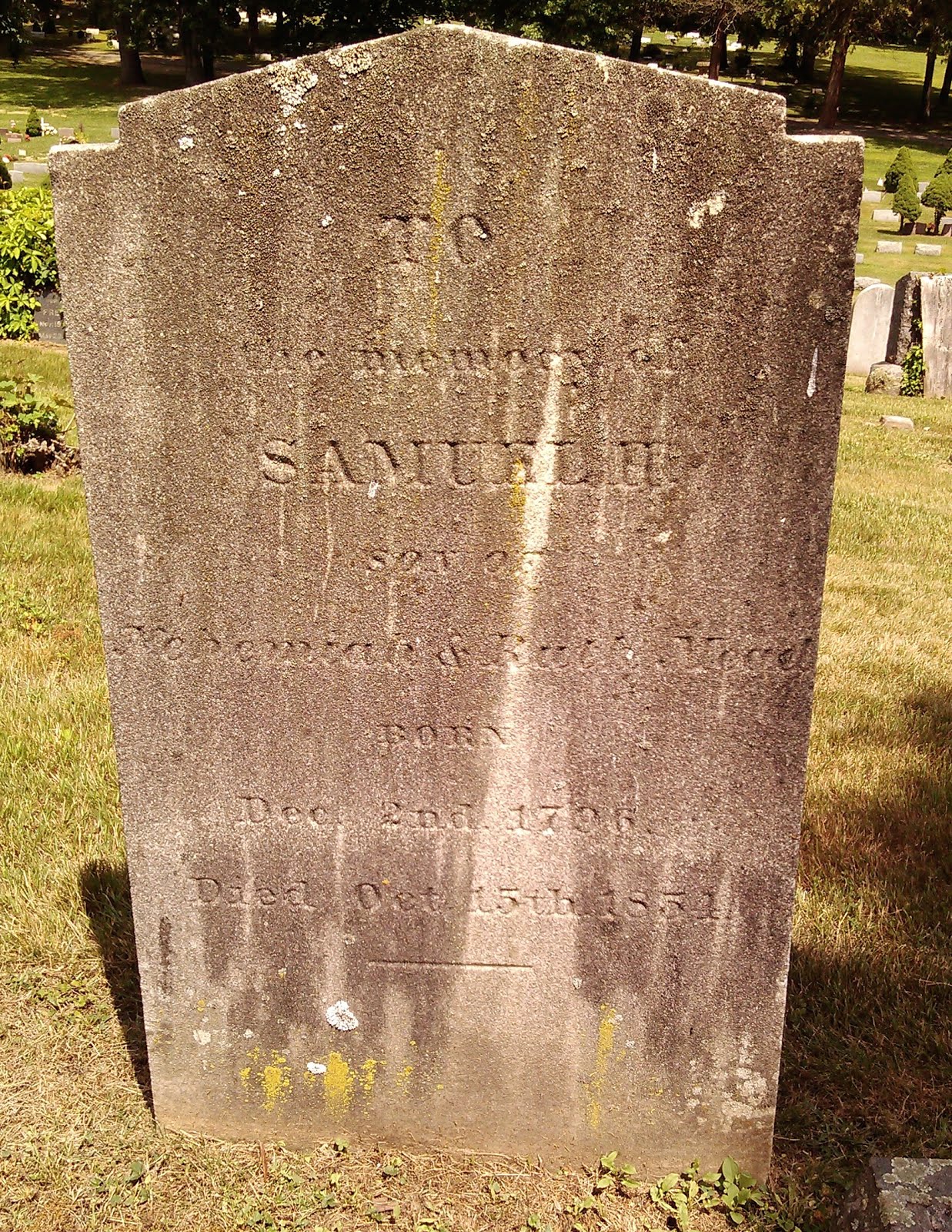
Featured here are some examples of the weeping willow tree and urn motifs found on the gravestones of a few of our ancestors in Greenwich, Connecticut cemeteries.
Tuesday, July 6, 2010
Mead Burying Ground at Lot & Drake's Corner
Monday, July 5, 2010
The Silleck House, a Mead House, Built Circa 1827
Thursday, May 13, 2010
The Passing of Herbert Bingham Mead 1924-2010
(Note: I have established another blog about the book I am researching on my father's service in postwar China. Go here: MyDadtheUSChinaMarine.blogspot.com)
Dad died in the closing moments of his 86th birthday at a nursing home in Croton-on-Hudson, New York on February 25. He is dearly missed. Dad enthusiastically supported the creation of our cemetery association in 1990. In his younger days he maintained the cemetery property off Relay Place near Cos Cob's Mill Pond. When he and my mother were first married they lived in a small cottage nearby that has since been demolished. Up until five years ago Dad would go down to the Cos Cob plot and two others the Association maintains and keep them in good order.
He was a World War II veteran serving as a radioman in the U.S. Marines 1st and 4th Marine Division from 1943 to 1947, at Guadalcanal, Peleiu, the front lines in the Battle of Okinawa, and stationed for several years in Tianjin and Beijing, China after the Japanese surrender.
For many years he was employed in the Clairol’s research division of the Bristol-Myers Squibb Corporation in Stamford, Connecticut. After his retirement he started and operated a garden design and landscape business until six years ago.
My father was an active and passionate volunteer for over 40 years in Greenwich’s fire department services including serving as chief of the Round Hill Volunteer Fire Department and the Amogerone Volunteer Fire Company, contributing his time and energies. He was also a proud supporter of various US Marine Corps organizations.
I am very grateful for his guidance and support when the Association was first created and in the years since. Rest in peace, Dad. Thank you for all that you did -and for your example.
Jeffrey Bingham Mead