For as far back as anyone alive today can remember the family burying ground at Cos Cob has posed a mystery.
Upon ascending up into the cemetery visitors notice a small downswing off to the right side closest to the Mill Pond. Why was it there? It certainly did not appear to conform to the rest of the landscape.
I was going through my collection of 35mm slides for donation to the Greenwich Historical Society’s archives. This collection mostly consists of research I conducted on the cemeteries in Greenwich, Connecticut during the 1980s and early 1990s. I had some of these professionally scanned.
While going through them I noticed the image pictured above.
The area in question was the site of graves that were disinterred in the 1880s. The image is one taken of records kept at Greenwich’s Town Hall showing that a number of graves were disinterred from this cemetery and reinterred in Putnam Cemetery.
The name ‘Thomas Young’ is the sexton who, by definition, is someone employed or perhaps a church officer whose responsibility is to care for church property, including the digging of graves.
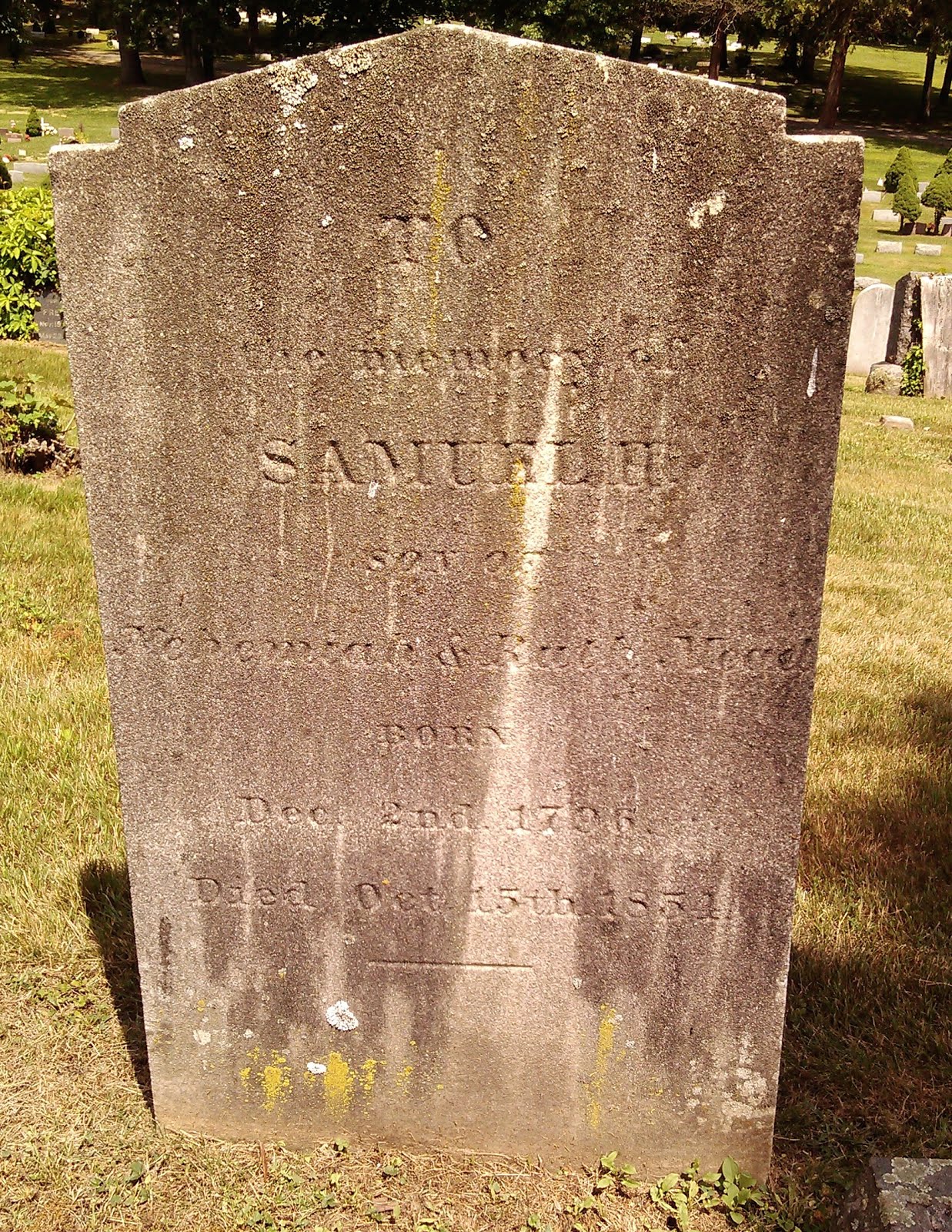
This is where the graves are today in Putnam Cemetery off Parsonage Road:
The names and dates of those disinterred are:
Samuel H. Mead, son of Nehemiah and Ruth Mead, b. December 2, 1796, d. October 15, 1854:
Henry Richards, son of James and Ruth Richards of Norwalk, d. September 28, 1800, aged 17 years and 9 months:
Nehemiah Mead, Jr., d. March 21, 1826, aged 54 years, 3 months and 17 days:
Nehemiah Mead. Sr., d. August 16, 1791, aged 70 years:
Mrs. Ruth Mead, wife of Nehemiah Mead, b. April 25, 1770, d. February 13, 1854:
Mrs. Sarah Mead, d. August 20, 1808, aged 74 years, 3 months and 27 days:
Sarah Mead, daughter of Nehemiah and Ruth Mead, d. May 12, 1871, aged 72 years, 10 months and 9 days.
Aside from the list of names, the genealogical information was taken from Spencer P. Mead’s Abstract of Records of Tombstones of the Town of Greenwich, Connecticut, 1913.
As to why the graves were disinterred, that remains a mystery. I suspect it always will be.
Jeffrey Bingham Mead